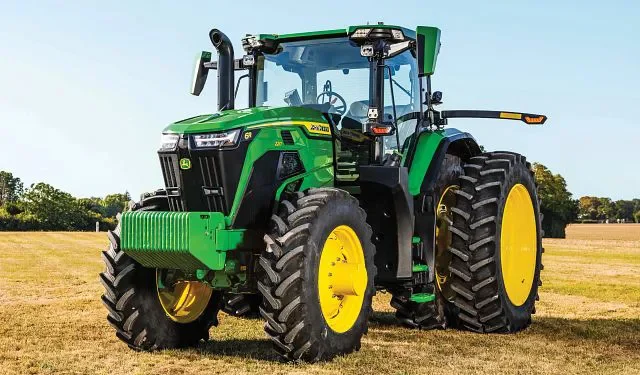
John Deere used its June 8 global product launch to unveil a series of Model Year 2027 updates across its 6M and 6R tractor families. The announcement included a new flagship 6R260 rated at up to 305 horsepower with Intelligent Power Management, updated cab technology, new transmission options, expanded precision agriculture capabilities, and a range of operator comfort improvements. At the same time, Deere continues rolling out the larger 8R and 8RX updates it introduced earlier this year, extending horsepower options all the way to 540 horsepower.
On the surface, these are the kinds of annual product updates farmers have come to expect from major equipment manufacturers. New horsepower ratings, new cab features, and new technology packages are nothing unusual. Look a little closer, however, and a larger pattern begins to emerge.
The June 8 announcement was not really about a single tractor. Instead, it offered another glimpse into how Deere is gradually reshaping its entire lineup. The traditional lines between utility tractors and row crop tractors are becoming increasingly difficult to define, and Deere appears to be accelerating that trend.
The 6R Is No Longer Just a Utility Tractor
The clearest example is the new 6R260.
With up to 305 horsepower available through Intelligent Power Management, Deere’s newest 6R enters territory that was once firmly associated with row crop tractors. While horsepower alone does not determine a machine’s capabilities, it illustrates just how much the role of the utility tractor has evolved.
The updates go beyond engine performance. Deere’s large-frame and extra-large-frame 6R models receive the new CommandView 4 cab, improved visibility, lower noise levels, upgraded controls, and a new e19 Full Powershift transmission designed to improve both field performance and road transport. These are features aimed at operators who spend long days in the seat and expect the same level of refinement found in larger machines.
That reflects how many farms use these tractors today. A modern 6R might handle planting in the spring, loader work throughout the year, hay production during the summer, and grain cart duties during harvest. For many operations, it is no longer a supporting machine. It has become one of the primary tractors on the farm.
The 6M Continues Moving Upmarket
The same trend is visible in the 6M lineup.
Historically, the 6M served as Deere’s practical, value-oriented utility tractor, while the 6R represented the premium option. Those distinctions still exist, but the gap continues to narrow as technology and comfort features move deeper into the 6M range.
The updated models receive improved operator controls, expanded technology integration, and additional comfort features that would have been difficult to imagine on a mid-range utility tractor a generation ago. As precision agriculture becomes increasingly important across all types of operations, Deere appears focused on making its technology ecosystem available to a broader range of customers rather than reserving it for the highest-end machines.
That shift reflects a broader reality in agriculture. Guidance systems, connectivity, and precision farming tools are no longer limited to large row crop farms. Livestock producers, hay operations, mixed farms, and specialty producers increasingly expect access to the same technology.
Meanwhile, the 8R Keeps Growing
While Deere’s utility tractors continue becoming more capable, its row crop tractors are moving in the opposite direction.
Earlier this year, the company introduced new 8R and 8RX models producing up to 540 horsepower, with peak output reaching as much as 634 horsepower through Intelligent Power Management. The machines also received substantial upgrades in hydraulics, transport capability, operator comfort, and precision agriculture integration.
Taken together, these developments reveal a clear strategy. Rather than maintaining rigid boundaries between tractor families, Deere is expanding the range of work each series can perform.
The 6R is taking on jobs that once belonged to larger row crop tractors. The 8R is pushing into territory that was traditionally occupied by articulated machines. The overlap between categories continues to grow.
Deere Is Building a More Unified Lineup
Perhaps the most important aspect of the June 8 announcement has little to do with horsepower at all.
Across the 6M, 6R, and 8R families, Deere is steadily creating a more consistent operator experience. Cab layouts, displays, controls, software systems, and precision agriculture tools are becoming increasingly standardized. Whether an operator climbs into a utility tractor, a row crop tractor, or something larger, the experience is becoming more familiar.
That may seem like a small detail, but it matters on farms that operate multiple machines and employ multiple operators. Reducing training time, simplifying technology adoption, and creating consistency across equipment can be just as valuable as adding horsepower.
It also reflects a shift in how modern tractors are sold. Farmers still care about engine performance, lift capacity, and hydraulic flow, but they are increasingly evaluating machines based on connectivity, comfort, automation, and ease of use. Deere appears to recognize that reality and is designing its lineup accordingly.
The Bigger Takeaway
For all the attention paid to the new 6R260, the updated 6M models, and the latest 8R horsepower figures, the June 8 launch may ultimately be remembered for something else.
It highlighted a long-term transformation already underway across Deere’s tractor lineup.
Utility tractors are becoming more powerful. Row crop tractors are becoming more versatile. Technology is becoming more consistent across machine categories. As those trends continue, the distinctions that once defined Deere’s lineup become less important than the jobs each tractor can perform.
For farmers and dealers alike, that may be the most significant message hidden within Deere’s latest round of product updates.

Leave a Reply