
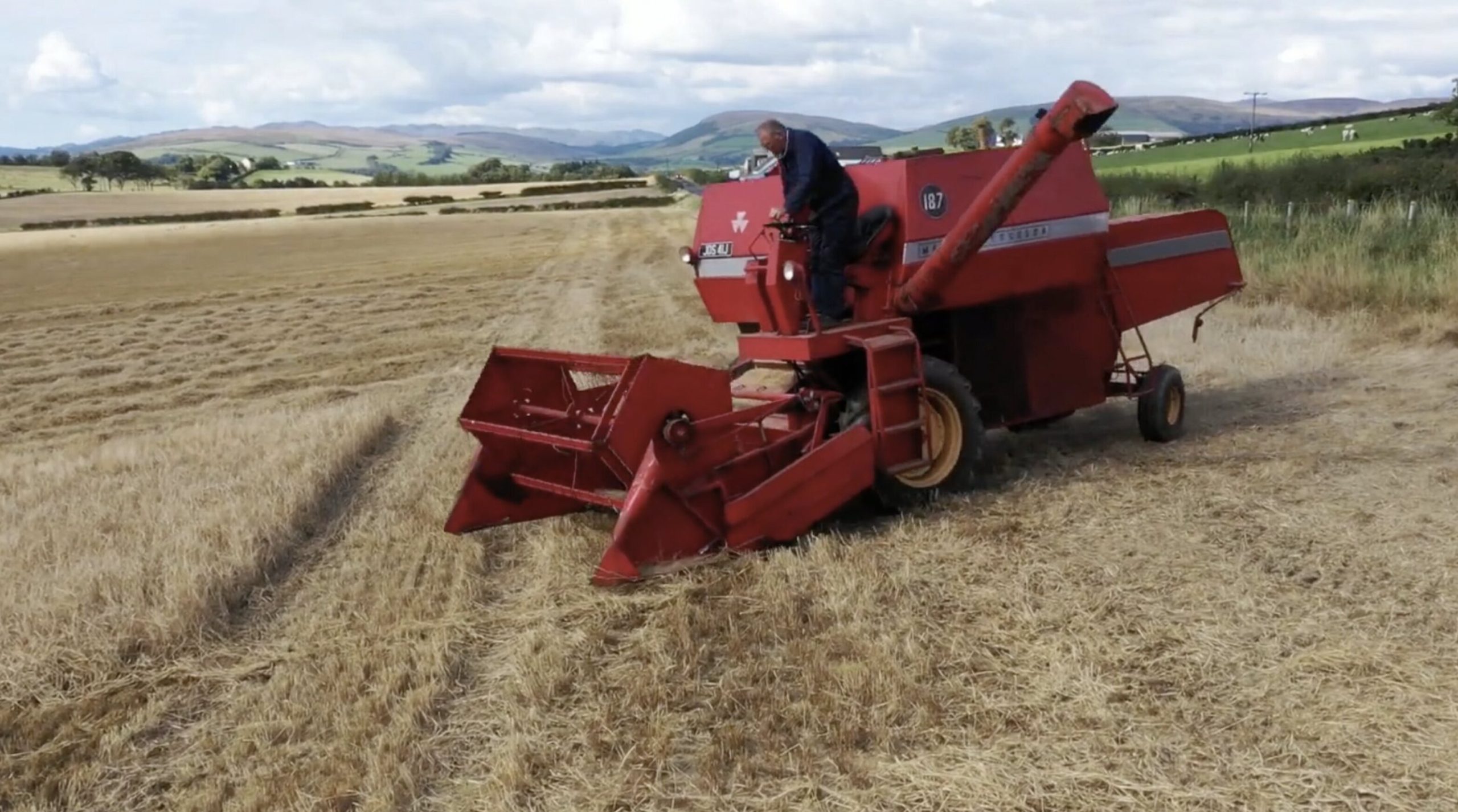
Most combines built in the early 1970s disappeared from working farms decades ago. They were traded for larger machines, parted out or scrapped, while a fortunate few survived as collector pieces. But some Massey Ferguson 187 combines apparently never got the message that their working days were over.
One 1971 MF 187 is still being used to harvest grain in Spain more than half a century after it was built. And it isn’t alone. A 1970 example has survived on Scotland’s Isle of Bute, while another 187 from 1972 has surfaced in Slovenia in operational condition. Their survival raises an interesting question: What is it about a machine like the MF 187 that can allow it to remain useful more than 50 years later?
A Combine From Another Era
The Massey Ferguson 187 belongs to an entirely different generation of harvesting equipment. Early versions were powered by a naturally aspirated Perkins four-cylinder diesel producing around 62 horsepower, with headers available around the 10-foot range.
The 1971 machine still harvesting today reportedly has a header just under 10 feet wide and a grain tank holding roughly 63 bushels. Its owner is said to harvest approximately 4.9 acres per day on an operation of about 49 acres. A modern high-capacity combine could cover that ground remarkably quickly, but that comparison also helps explain why the Massey can still make sense. Its owner doesn’t have thousands of acres waiting to be harvested.
Today’s largest combines can produce more than 700 horsepower, work with headers approaching 50 feet wide and carry hundreds of bushels of grain. They also bring guidance, yield monitoring, cameras, sensors and automation that would have been unimaginable when the MF 187 was new. The old Massey can’t compete with any of that, but on a small enough operation, it doesn’t necessarily have to.
More Than One Has Survived
Finding a single 1971 combine still harvesting could be dismissed as an unusual case involving a particularly dedicated owner. Other surviving MF 187s suggest the story is a little broader.
A 1970 Massey Ferguson 187 surfaced on Scotland’s Isle of Bute in 2023, when video showed the combine being offered for sale. According to the seller, it had always been stored indoors when not in use.
Another 187, built in 1972, has been advertised in Slovenia in original, well-preserved condition. That machine has a 3-meter header, was reportedly purchased new in Germany and is now on its second owner, with the seller describing it as mechanically sound and ready for work.
Other surviving 187s have surfaced around Europe over the years as well. That doesn’t mean large numbers are still harvesting commercially, but it does show that the machine working today isn’t the only MF 187 to have enjoyed an exceptionally long life.
Simplicity Helps Keep Old Iron Alive
Part of the explanation becomes obvious when looking at how a combine of this era was built. There are no electronic control modules, emissions systems or computerized diagnostic networks. Much of the machine consists of mechanical systems that an experienced farmer or mechanic can inspect, adjust and repair using conventional tools and knowledge.
Keeping a half-century-old combine running still isn’t easy. Bearings wear out, belts and chains fail, metal fatigues and model-specific parts become increasingly difficult to find. Owners may have to locate used components, rebuild existing parts or adapt replacements, but a relatively simple mechanical failure doesn’t necessarily render the entire machine unusable.
Storage also matters. The history given for the Isle of Bute machine is a good example. Keeping machinery indoors protects sheet metal, electrical components, belts, bearings and other parts from decades of exposure to the elements. Over 50 years, those differences can determine whether a machine remains usable or becomes a source of parts for another one.
When More Capacity Doesn’t Make More Money
The other reason an old combine can survive has less to do with engineering than economics. If a farmer has roughly 49 acres to harvest, there is limited financial value in owning a machine capable of covering hundreds of acres per day. A larger combine could finish much faster, but it wouldn’t create additional acres or additional grain.
A paid-for older machine also has a very different ownership equation. Most of its depreciation occurred decades ago, and if annual repairs remain manageable and the machine can finish harvest within an acceptable window, replacing it simply to gain capacity may make little financial sense. The most productive machine isn’t necessarily the most profitable machine.
That equation changes dramatically as farms get larger. Harvest windows are limited, weather delays can be expensive and labor is increasingly difficult to find. Modern combines became enormous and sophisticated because large farms genuinely need their productivity.
Old Doesn’t Mean Better
The survival of these Masseys shouldn’t become another argument that “they don’t build them like they used to.” Modern combines are safer, faster and substantially more comfortable, while allowing one operator to harvest quantities of grain that would once have required several machines and several people.
Automation can reduce operator fatigue and optimize machine settings, while modern systems provide real-time information about yield, moisture, grain loss and machine performance. For a large commercial grain operation, returning to a 62-horsepower combine with a 10-foot header would be completely impractical.
The interesting thing about the MF 187 isn’t that it is somehow better than a modern combine. It’s that technological superiority doesn’t automatically make an older machine useless.
When Is a Machine Actually Obsolete?
Farm equipment can become technologically obsolete long before it becomes economically obsolete. By virtually every modern performance measurement, an MF 187 is outdated, with a fraction of the horsepower, capacity and technology available today. Yet if it remains dependable, inexpensive to operate and capable of harvesting the acres available to it, those shortcomings may not matter much to its owner.
Eventually, repairs, downtime, parts availability or changing farm needs make replacement the better option. Most MF 187s undoubtedly reached that point decades ago, but a few remarkably haven’t. More than half a century after they were built, these surviving Masseys are still capable of doing the job that matters most: getting the crop out of the field and into the grain tank.


Leave a Reply