
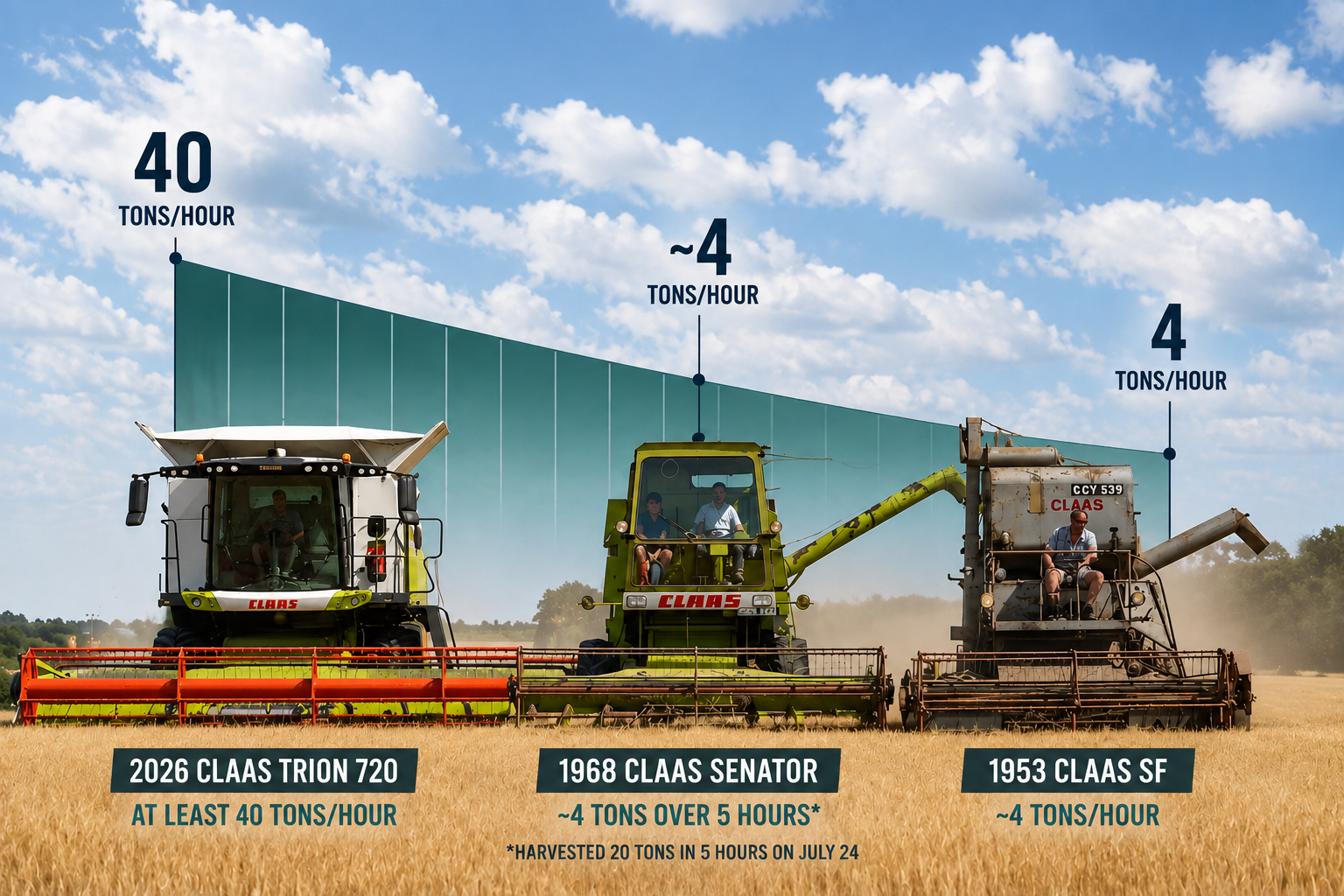
Put a 1953 combine, a 1968 combine and a modern machine in the same wheat field, and you get a pretty remarkable picture of how much harvesting has changed over more than 70 years.
That is exactly what CLAAS recently did in England, bringing together a 1953 CLAAS SF, a historically significant 1968 SENATOR and a modern TRION 720 at Honey Hill Farm in Little Saxham. All three machines harvested wheat in the same field, turning a vintage machinery demonstration into a real-world look at three very different generations of combine technology.
As reported by World Agritech in its recent piece, “A Legend Returns to the Field,” the event centered in part around the return of a particularly important SENATOR. The machine was the 200,000th combine produced by CLAAS and was originally presented by company founder August Claas to Scottish farmer John Steven in August 1968. After returning to CLAAS UK and being restored to working condition, it was ready to harvest again nearly six decades after it was built.
Three Generations in One Field
The July 31 demonstration brought the 1953 SF, 1968 SENATOR and modern TRION 720 together near CLAAS UK’s headquarters. While the machines share the same basic purpose, seeing them work alongside one another made the enormous changes in harvesting technology and capacity particularly easy to appreciate.
The 1953 SF harvested at approximately four tons per hour, while the modern TRION 720 reached at least 40 tons per hour, roughly 10 times the throughput. That difference represents far more than bigger engines and wider headers. Over the decades, combines have gained increasingly sophisticated threshing and separation systems, greater cleaning capacity, improved grain handling and electronics that allow operators to monitor and adjust machine performance in ways that would have been unimaginable when the SF was built.
The operator’s job has changed just as dramatically. Modern combines place operators in climate-controlled cabs surrounded by displays, sensors and automated systems designed to help maintain performance and reduce losses. The old machines provide a reminder of how much more mechanical and hands-on harvesting once was, even though the fundamental process taking place inside the machine remains recognizable.
The 1968 SENATOR Still Had Work to Do
Before the three-generation demonstration, the SENATOR had already proven that its return to the field was more than ceremonial. On July 24, the restored machine harvested roughly 20 tons of wheat over five hours on the Suffolk farm of George and Freddie Gittus.
Its history makes that accomplishment especially notable. The SENATOR was CLAAS’s 200,000th combine, a milestone the company reached only six years after producing its 100,000th. The machine dates to a period when mechanized harvesting was expanding rapidly and combine manufacturers were developing larger and increasingly capable machines for farms across Europe and elsewhere.
The SENATOR also represented an important period in the evolution of the CLAAS brand itself. The model arrived with more contemporary styling, a new corporate identity and the Seed Green color that would become closely associated with CLAAS machinery.
After decades in Scotland, the milestone SENATOR eventually returned to CLAAS UK’s headquarters in Saxham in 2025. The company’s technical service team restored it to operating condition while preserving its patina rather than attempting to make the machine look new. CLAAS says its World Parts Centre in Hamm, Germany, was even able to provide many of the original components required for the restoration.
Old Iron Meets Modern Technology
There was also a distinctly modern element to putting the SENATOR back to work. During its return to harvest, CLAAS’s digital team tracked the machine using CLAAS connect, effectively bringing a combine designed in the 1960s onto a modern connected-farming platform.
That contrast may be as revealing as the difference in harvesting capacity. Today’s combines increasingly operate as connected machines, collecting information about their own performance and the crop while allowing operators to make adjustments using data that farmers in the 1950s and 1960s simply did not have.
Yet watching all three machines travel through the same wheat also highlights how much has stayed the same. The headers cut the crop, the machines separate the grain and each leaves a harvested field behind it. More than seven decades of engineering have made that process dramatically faster, more comfortable and increasingly automated, but the fundamental objective has hardly changed.
More Than 70 Years of Combine Progress
Vintage farm machinery is often displayed at shows or parked in collections, where its history can be appreciated without necessarily seeing what it was designed to do. Putting these three CLAAS combines back into wheat offered something different.
The 1953 SF showed where self-propelled CLAAS harvesting technology was more than 70 years ago. The 1968 SENATOR represented another stage in that evolution and an important production milestone for the company. The TRION 720 showed just how far capacity, operator comfort and technology have progressed since then.
The approximately four-ton-per-hour performance of the SF compared with at least 40 tons per hour from the TRION provides the easiest number to measure, but the three machines together tell a larger story. Farmers have gained the ability to harvest substantially more crop in increasingly narrow windows while using machines that can monitor, adjust and communicate in ways their predecessors could never have anticipated.
And perhaps the most impressive part is that the two old combines can still do the job. Put machines built in 1953, 1968 and today into the same wheat field, and more than 70 years of agricultural engineering suddenly becomes something you can see working right in front of you.


Leave a Reply