
For decades, precision agriculture has been discussed as technology farmers were gradually “adopting.” A new survey from CNH suggests that, at least for some of the most established technologies, that may no longer be the best way to describe what is happening.
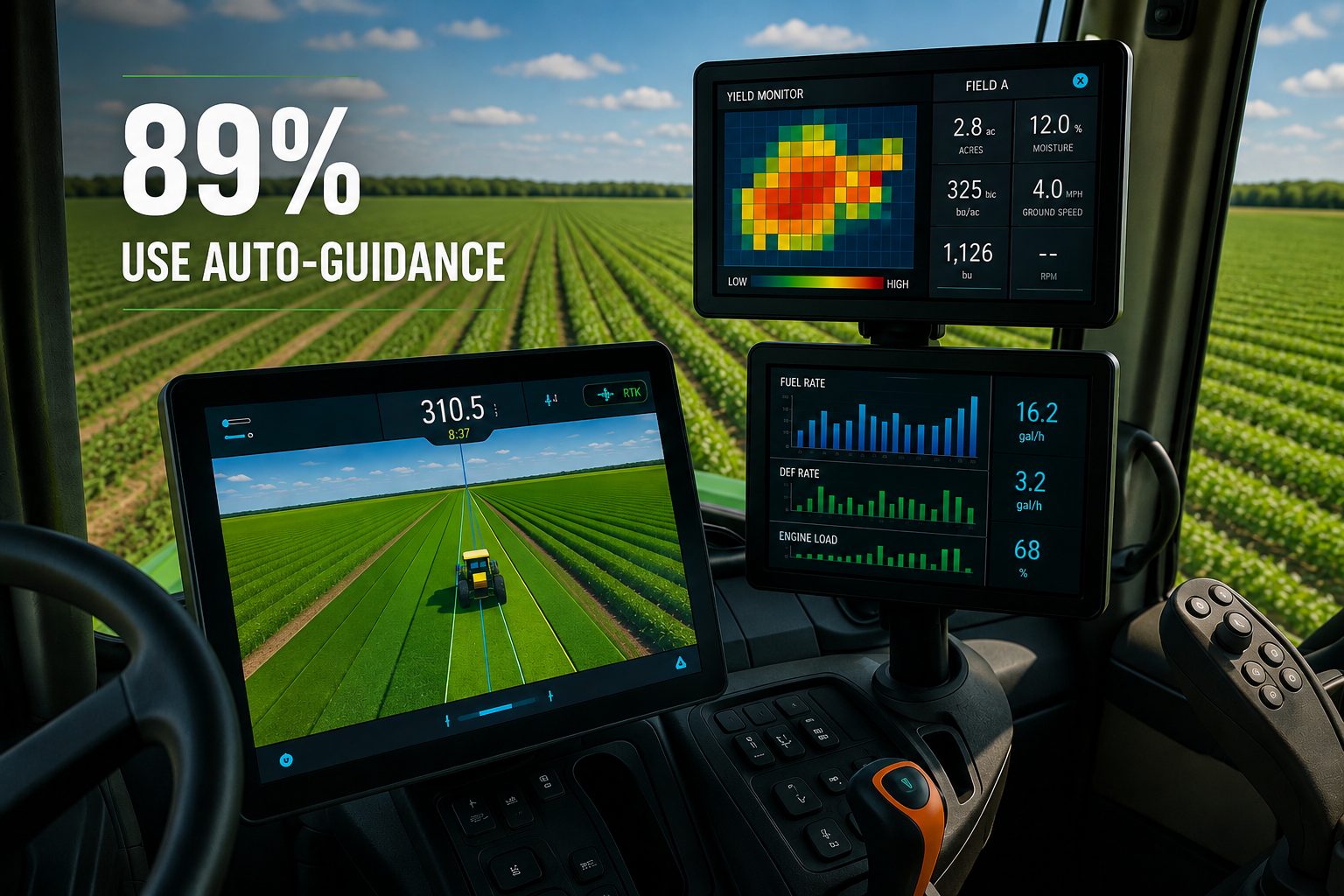
CNH’s inaugural Farmer Pulse: The AgTech Adoption Edition surveyed 217 farmers and ranchers across the United States and Canada, and the results show just how deeply precision technology has worked its way into modern farming. Among respondents, 89% reported using auto-guidance, 71% said precision technology is important to the success of their operation, and more than half expect to invest in additional precision technology within the next two years.
Those numbers raise an interesting question for the machinery industry: At what point does precision ag stop being an optional technology category and simply become part of the equipment farmers expect to have?
Precision Ag Has Moved Into the Mainstream
Auto-guidance offers perhaps the clearest example. An 89% usage rate among CNH’s respondents suggests a technology that was once a major innovation has become routine on many operations. That finding isn’t entirely isolated, either. McKinsey’s 2024 Global Farmer Insights survey also found tractor guidance or autosteering was among the most widely adopted precision-ag applications among North American respondents.
The same transition can increasingly be seen in newer equipment. Guidance, connectivity, machine monitoring and varying degrees of automation are being integrated directly into tractors, combines, sprayers and implements rather than always being treated as separate add-ons. CNH itself has made what it calls “Iron + Tech” integration a major part of its strategy, with plans to nearly double Precision Tech sales as a percentage of its agricultural sales by 2030.
That doesn’t mean every precision technology has reached the same level of adoption. Guidance is mature compared with newer applications involving artificial intelligence, targeted spraying and autonomy. But the broader trend suggests the distinction between the machinery and the technology operating it is becoming increasingly difficult to make.
Farmers Are Looking for a Return
The reasons farmers gave for adopting technology may be more revealing than the adoption numbers themselves. According to the CNH survey, 74% cited reducing input costs as a benefit of precision technology, while 70% pointed to improved time or labor efficiency and 59% cited increased yields.
Those priorities are particularly relevant when farm margins are under pressure. Saving seed, fertilizer, chemicals, fuel or an operator’s time can provide a much easier justification for a technology purchase than simply adding another layer of data to the operation.
Manufacturers appear increasingly aware of that distinction. CNH has highlighted technologies such as targeted spraying, automated planting and combine automation around measurable savings or productivity gains. The company says its sense-and-act spraying technology can reduce herbicide use by as much as 60%, while its combine automation has produced greater throughput and higher net revenue per hectare in wheat trials.
The direction is clear: Farmers may be increasingly comfortable with precision technology, but manufacturers still have to demonstrate what that technology does for the bottom line.
Cost and ROI Are Still the Obstacles
That becomes especially apparent in another part of the Farmer Pulse survey. While adoption is high, 56% of respondents identified cost as a barrier to precision technology and 36% cited uncertainty about return on investment. Training, connectivity and ease of use were also concerns, although they ranked lower.
That creates an interesting shift in the precision-ag conversation. The challenge is increasingly less about convincing farmers that technology has a place on the farm and more about proving that the next technology is worth buying.
A farmer who already uses auto-guidance doesn’t necessarily need to be persuaded of the benefits of precision agriculture. The harder question is whether the next level of automation, sensing, connectivity or AI can save enough money, labor or time to justify its cost.
That could raise the bar considerably for the next generation of ag technology. Features that generate additional information without making a farmer’s job easier or more profitable may have a harder time competing for investment, particularly when equipment costs are already high.
The Technology Is Becoming Part of the Machine
The machinery itself is also changing in response. CNH has said it is moving toward factory-installed precision systems across its major product lines while increasing the integration between its equipment and technology. Its FieldOps platform brings machine and agronomic information together, while increasingly sophisticated automation is being incorporated into planting, spraying, tillage and harvesting equipment.
A modern New Holland CR10 combine, for example, comes standard with a precision technology package that includes IntelliSteer auto-guidance and IntelliSense harvest automation. The latter can automatically adjust combine settings according to priorities selected by the operator, such as grain quality, capacity, throughput or limiting losses. More advanced technology packages add higher-accuracy guidance and additional data capabilities.
That is a very different relationship between technology and machinery than farmers encountered during the early years of precision agriculture. Instead of buying a machine and then deciding whether to add technology to it, farmers are increasingly buying machines in which the technology is part of the overall package.
What Comes After Adoption?
CNH’s survey found that 54% of respondents expect to invest in additional precision technology during the next two years. That suggests there is plenty of room for the market to continue growing, even as technologies such as auto-guidance become commonplace.
Where that money goes may depend increasingly on whether newer systems can move beyond collecting information and begin turning it into useful actions. Automation that adjusts a combine while harvesting, cameras that identify weeds before a sprayer applies product, or planting systems that automatically maintain accurate placement all represent steps in that direction.
CNH is already betting heavily on that future. Its longer-term technology strategy includes greater use of AI, automation, autonomous machinery and connected equipment throughout the crop production cycle, while maintaining a focus on measurable productivity and input savings.
The Farmer Pulse results suggest precision agriculture may be reaching an important point in its evolution. Technologies that once demonstrated what was possible are becoming ordinary pieces of farm equipment, and farmers appear willing to keep investing.
But mainstream adoption doesn’t make the next sale automatic. If anything, it may make farmers more demanding. As precision technology becomes an expected part of modern machinery, the next generation will increasingly have to answer a straightforward question: What will this technology actually do for my operation?


Leave a Reply