American farmers shopping for a 300-plus-horsepower tractor have plenty of familiar choices. John Deere, Case IH, New Holland, Fendt and other established brands all compete for a place in that part of the machinery shed, but JCB is offering something noticeably different.
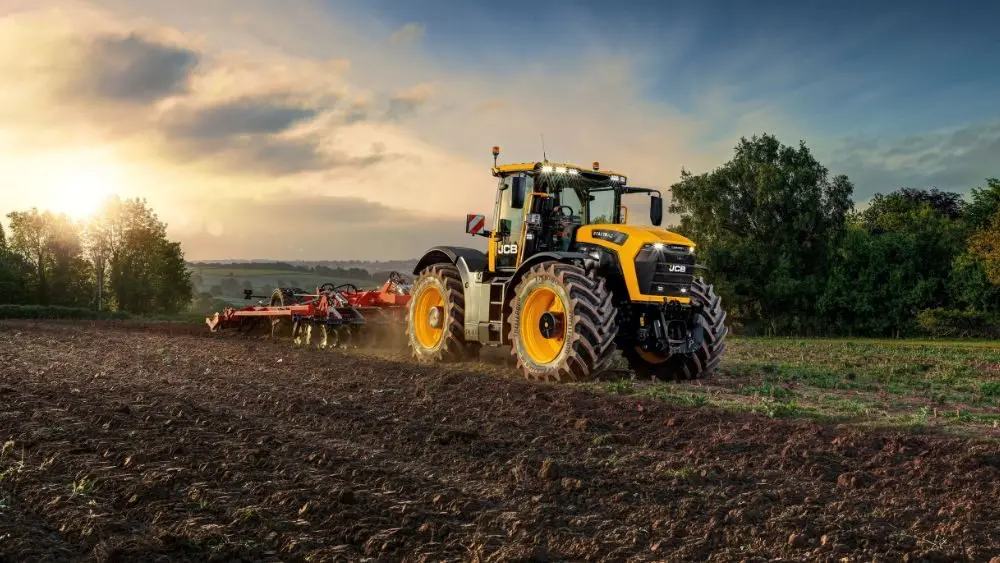
The British manufacturer is bringing its new 335-horsepower Fastrac 6300 to the 2026 Farm Progress Show in Boone, Iowa, giving many U.S. farmers their first close look at a tractor designed around a philosophy JCB has pursued for more than three decades: a high-horsepower tractor should be nearly as capable traveling between fields as it is working in them.
That means a top speed of 41 mph, suspension on both axles, four-wheel steering and serious attention to braking and stability. With the 6300, however, JCB is also making the case that those distinctive Fastrac traits belong on a modern high-horsepower field tractor.
335 Horsepower and 41 MPH
At the heart of the Fastrac 6300 is a 6.7-liter FPT six-cylinder diesel producing 335 horsepower and up to 1,400 Nm, or roughly 1,033 lb.-ft., of torque. It’s paired with a continuously variable ZF transmission and JCB’s Smart Transmission Control system.
Those numbers put the 6300 squarely into a horsepower class populated by some of the most important tractors on large U.S. farms. What separates it is what happens when the tractor leaves the field. The Fastrac can travel at speeds up to 41 mph where regulations allow, with double-acting suspension at both the front and rear axles, anti-roll bars and ABS braking helping make those speeds practical.
High road speed has always been central to the Fastrac idea. JCB introduced the original Fastrac in the early 1990s with the premise that tractors spent too much productive time slowly traveling between jobs. That argument is particularly easy to understand in Europe, where farms and contractors may move frequently between scattered fields, but it may have increasing relevance in the United States as well.
As farms grow and operators cover more acres, moving a tractor several miles between fields can become a meaningful part of the workday. During planting, spraying, tillage and other time-sensitive operations, cutting transport time can translate directly into more acres covered before conditions change.
More Than a Fast Tractor
JCB appears determined to keep the 6300 from being defined solely by its road speed. The tractor uses four-wheel steering, including a Twin Steer guidance system that can automatically control both axles. Two satellite receivers help the system maintain accuracy, particularly over rolling ground, while automated headland-turn functions further integrate the tractor into precision farming operations.
An optional central tire inflation system addresses another challenge created by building a machine for both road and field use. Operators can increase tire pressure for transport and lower it for field work, helping improve traction and reduce soil compaction without manually adjusting every tire when conditions change.
Hydraulic capacity is also substantial. Standard flow is 205 liters per minute, or about 54 gallons per minute, while the 6300 can be equipped with a twin-pump system providing as much as 410 liters per minute, or roughly 108 gallons per minute. Rear three-point lift capacity is approximately 24,250 pounds.
Taken together, those specifications make the Fastrac considerably more than a specialized transport tractor. JCB is positioning the 6300 for heavy field work, high-capacity implements and operations where tractors may spend a significant amount of time moving between road and field.
A Different Approach to Tractor Design
The Fastrac has always looked a little different because it is built differently. Conventional agricultural tractors typically use a rigid rear axle, with suspension concentrated at the front axle and cab. JCB’s approach suspends both axles and uses a full-length chassis, allowing the tractor’s suspension, steering and braking systems to behave more like those of a high-speed vehicle.
The 6300 also maintains a roughly 50:50 weight distribution and uses four equal-sized wheels. Four-wheel steering helps compensate for what could otherwise be a large turning circle on a tractor of this size, while the suspension and chassis design help make its unusual road performance possible.
That combination gives JCB a distinctive pitch in a market where manufacturers often compete over relatively small differences in horsepower, hydraulic capacity, cab technology and precision-ag features. The Fastrac is asking farmers to consider whether a tractor that spends part of its working life on the road should be designed from the beginning with that job in mind.
Does the Fastrac Formula Make Sense in America?
That may be the more interesting question as the 6300 arrives in front of U.S. farmers. A 41-mph tractor has obvious appeal where operators regularly travel long distances between fields, while full suspension could make those trips considerably more comfortable for operators spending 10 or 12 hours in the cab.
The American high-horsepower tractor market is fiercely competitive, though, and purchasing decisions involve far more than comparing specifications. Deere and Case IH have enormous installed bases and dealer networks, while New Holland, Fendt, CLAAS and other manufacturers give farmers additional choices. Parts availability, dealer support, resale value and familiarity can matter just as much as horsepower or road speed.
JCB does have an existing North American footprint, particularly through its construction equipment, Loadall telehandlers and other material-handling machines. The company is also investing heavily in the region, including a new $500 million manufacturing facility in San Antonio, Texas, giving the arrival of the Fastrac 6300 an interesting place within JCB’s broader North American expansion.
JCB isn’t likely to challenge the biggest U.S. tractor brands on volume anytime soon, and it doesn’t need to for the Fastrac to find a place here. Farms that move equipment frequently, custom operators covering large territories and farmers looking for a tractor capable of combining heavy field work with unusually fast transport could represent a natural audience.
The 6300 has already received international recognition, winning the Sustainable Tractor of the Year category for 2026. Now Farm Progress Show gives JCB an opportunity to put the tractor in front of American farmers and demonstrate whether the Fastrac concept translates to the way they actually work.
A 335-horsepower tractor capable of 41 mph will certainly attract attention. The more important question is whether enough U.S. farmers look at the Fastrac 6300 and decide its unusual approach solves a problem they actually have.


Leave a Reply