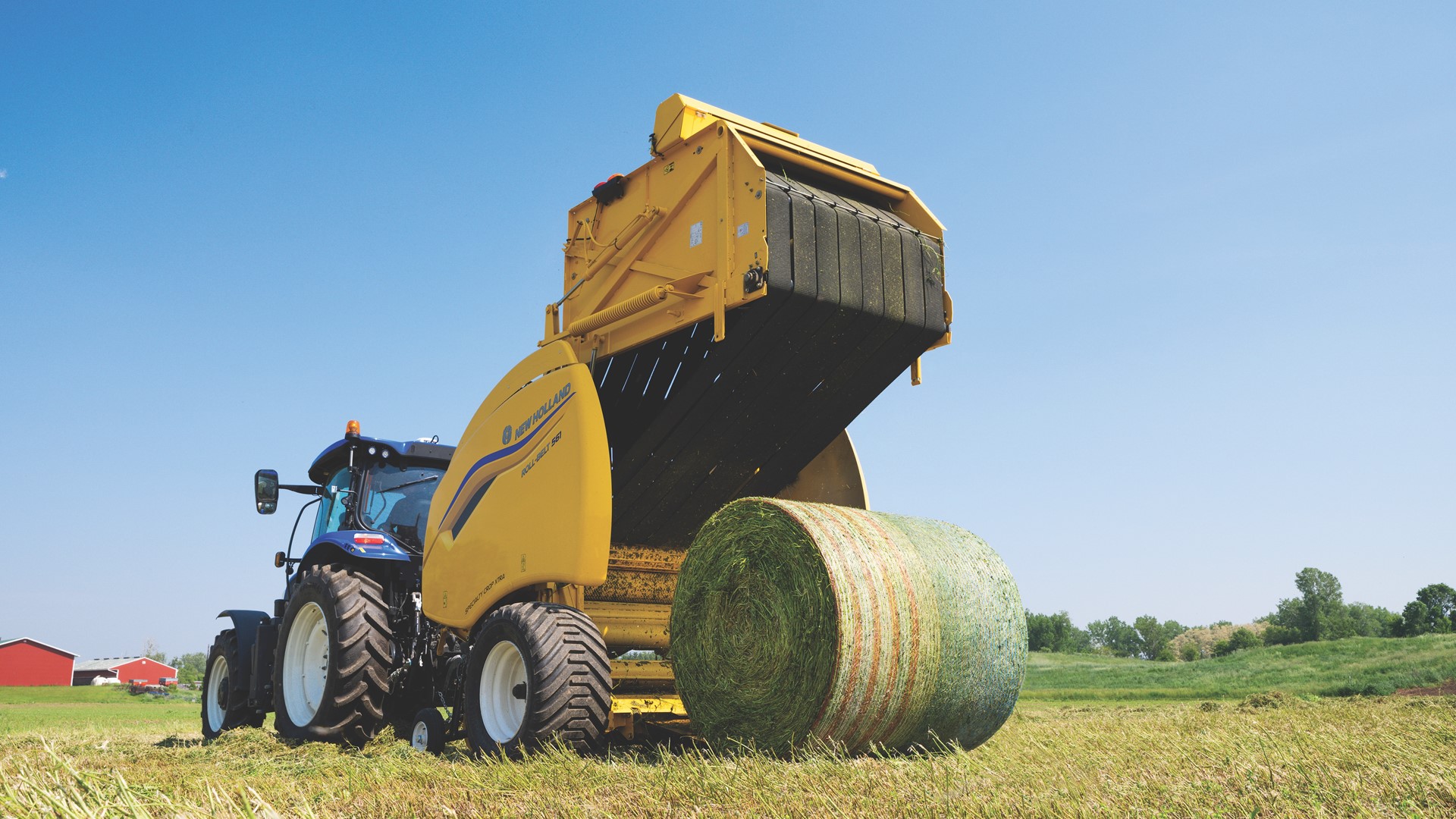
New Holland builds everything from compact tractors to combines today, but long before it became one of agriculture’s major full-line equipment brands, it made its reputation in the hay field. Now, the company appears to be putting that heritage back at the center of its identity.
At the 2026 Farm Progress Show, New Holland is making what it calls its “First in Grassland Farming” commitment a major theme. New windrowers, balers and increasingly sophisticated forage technology are all part of the effort, which New Holland describes as “re-staking our claim” to leadership in grassland farming.
That might sound like another marketing slogan, but New Holland has some history to back it up.
The Baler That Helped Build New Holland
New Holland’s haymaking reputation can be traced to Lancaster County, Pennsylvania, and farmer-inventor Ed Nolt. In the late 1930s, Nolt developed a commercially viable automatic self-tying pickup baler, solving one of the biggest labor problems associated with baling hay at the time. New Holland acquired the design and began producing the Model 73 in 1940, helping establish the company as a major agricultural equipment manufacturer.
The company continued building on that foundation. New Holland introduced its first self-propelled forage harvester in 1961 and the Haybine mower-conditioner in 1964, combining cutting and conditioning into a single operation. It later became a major player in round balers, windrowers and forage harvesters, and by 2008 its Pennsylvania plant had produced its 700,000th small square baler.
When New Holland talks about being “First in Grassland Farming,” then, it isn’t creating a new identity. It’s reaching back for one that helped build the company.
Making the Case for a Comeback
Of course, history doesn’t guarantee leadership forever. Deere, Case IH, Vermeer, CLAAS, Massey Ferguson, Kubota and others now compete aggressively across different parts of the hay and forage market. New Holland’s 2026 push appears to be an attempt to pair its heritage with a new generation of machinery and technology.
At Farm Progress Show, the company is introducing its Speedrower 1 Series self-propelled windrowers, with four models ranging from 161 to 308 peak horsepower. Beyond improvements to speed, capacity and operator comfort, the new Speedrowers can use Relative Yield Monitoring to map crop variability while cutting. That information can be stored through FieldOps and used to inform later decisions involving irrigation, nutrients, scouting and soil sampling.
New Model Year 2027 Roll-Belt 1 Series round balers are also part of the push, with durability improvements, updated operator technology and factory-installed IntelliBale automation. Together, the Speedrower and Roll-Belt updates refresh two product lines closely tied to New Holland’s haymaking identity.
From Mechanical Automation to AI
The more interesting evolution may be happening in forage harvesting. New Holland is introducing ForageCam for its FR Forage Cruisers, using image analysis to continuously evaluate kernel processing performance and automatically adjust crop processor settings to help maintain the desired forage quality.
There is an interesting connection between that technology and the machine that helped launch New Holland’s hay equipment business more than 85 years ago. Ed Nolt’s baler automated a difficult and labor-intensive part of making hay. Today, New Holland is working to automate decisions that once depended on an experienced operator watching the crop and manually adjusting the machine.
That progression may be the strongest argument behind New Holland’s renewed emphasis on grassland farming. The company isn’t simply putting an old reputation on new equipment. It’s trying to extend the same focus on productivity and automation that made its early hay equipment successful into an era of sensors, connectivity and artificial intelligence.
Back to Its Roots
New Holland has changed enormously since the Model 73 started rolling out of Pennsylvania in 1940. Through decades of expansion, acquisitions and mergers, the name eventually appeared on tractors, combines, sprayers, construction equipment and much more. Hay and forage, however, remain unusually important to the brand’s history.
So when New Holland says it is “re-staking” its claim to grassland farming, the choice of words is appropriate. This isn’t a company trying to break into a new category. It’s a company looking back at one of the markets that built its reputation and deciding it wants to lead there again.
Whether farmers are ready to give New Holland its haymaking crown back will ultimately be decided in the field. But with new windrowers and balers alongside increasingly automated forage technology, New Holland is making a serious case for it.
Leave a Reply