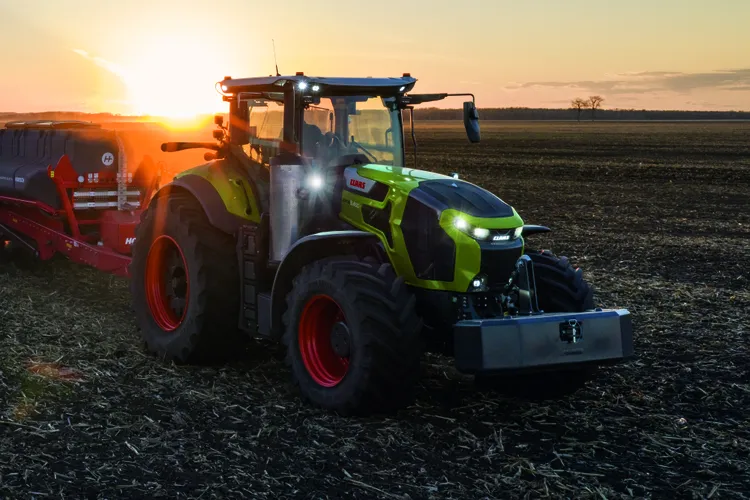
CLAAS may be best known in North America for its combines and forage equipment, but the German manufacturer is making a much bigger push into the tractor market.
At the 2026 Farm Progress Show, CLAAS introduced a new generation of ARION 6, AXION 8 and AXION 9 tractors covering a wide range of applications and horsepower. Together, the three series span from 165 to 450 horsepower, giving CLAAS new options for everything from livestock and hay operations to planting, grain carts, heavy tillage and seeding.
The changes go well beyond new styling. CLAAS has redesigned the operator environment, expanded automation and connectivity, and introduced smarter drivetrain management intended to let the tractor automatically adjust its performance to changing loads.
Three Series Cover a Lot of Ground
At the smaller end of the new North American lineup is the ARION 6 CMATIC, which replaces the previous ARION 600 Series. The two new models offer up to 165 and 205 horsepower and are aimed primarily at livestock, hay and forage, loader, transport and mixed-farm applications.
Despite being the smaller tractors of the group, they receive much of the technology found farther up the CLAAS lineup. Features include the company’s CMATIC continuously variable transmission, PROACTIV front-axle suspension and dynamic steering. A wheel-loader operating mode is designed to make repetitive loader work easier, while Apple CarPlay and Android Auto are available through the infotainment system.
The AXION 8 CMATIC moves CLAAS squarely into the heart of the row-crop tractor market. Three models range from 240 to 313 horsepower and are designed for jobs including planting, tillage, forage work and pulling grain carts.
The AXION 8 also gets a 54-gallon-per-minute load-sensing hydraulic system, more than 22,000 pounds of rear lift capacity and a standard front hitch.
At the top is the AXION 9 CMATIC, with seven models ranging from 330 to 450 horsepower. Both conventional wheeled and TERRA TRAC half-track configurations are available, positioning the series for heavy tillage, seeding, transport and other high-draft applications.
The largest AXION 9 tractors can provide up to 97 gallons per minute of hydraulic flow and nearly 25,000 pounds of rear lift capacity. TERRA TRAC models can carry as much as 227 gallons of fuel.
The Tractor Is Starting to Think Ahead
Some of the most interesting changes aren’t measured in horsepower.
CLAAS has expanded the amount of work the tractor’s electronic systems can handle automatically, particularly on the AXION models. Its new drivetrain management system coordinates the engine, CMATIC transmission and implement load rather than requiring the operator to constantly make adjustments.
One feature, called AUTO LOAD ANTICIPATION, actually learns how the implement is loading the tractor and attempts to anticipate what will happen next. AUTO DROOP automatically adjusts engine speed as conditions change, while intelligent power management makes additional horsepower available when it is needed.
The goal is to keep the tractor operating efficiently without requiring the driver to constantly manage engine speed and transmission settings.
Automation extends beyond the powertrain. Automatic headland management, guidance-line selection and intelligent implement controls can take over repetitive functions during fieldwork.
It’s another example of where modern tractor development appears to be heading. Manufacturers are still competing on horsepower, hydraulics and pulling capacity, but increasingly they’re also competing over how much of the operator’s workload the tractor can handle itself.
A Completely New Cab
CLAAS also put considerable attention into an area farmers experience every minute they spend in the tractor: the cab.
The redesigned cab can reach interior sound levels as low as 67 dB(A), according to CLAAS, and available equipment includes heated, ventilated and massaging seats, four-point cab suspension and as many as 22 LED work lights producing up to 56,000 lumens.
Operators can add a second 12-inch touchscreen along with high-resolution cameras. CLAAS’ CEBIS connect system brings tractor settings, implement controls and precision-ag functions together through the touchscreen interface.
Dynamic steering can also reduce the amount of steering-wheel movement required during loader work and headland turns.
Connected From the Field to the Dealership
The tractors are integrated with the CLAAS connect platform, allowing machine information and field data to move between the tractor, farm office and dealership.
Operators can transfer work orders, monitor machine location and performance, check maintenance information and automatically document field operations. Guidance lines can be shared between compatible machines, while remote display viewing gives dealer personnel another way to assist an operator without necessarily traveling to the field.
CLAAS has also extended engine oil service intervals to as much as 750 hours and is offering five-year/5,000-hour coverage on major drivetrain components through its MAXI CARE FOCUS program.
CLAAS Wants a Bigger Piece of the Tractor Market
Perhaps the biggest takeaway from the Farm Progress Show introduction is simply how broad the new lineup has become.
CLAAS has long had a significant North American presence in harvesting and forage equipment. Its tractor business, however, has faced a much more crowded market dominated by brands with enormous dealer networks and generations of customer loyalty.
The new ARION and AXION lineup gives CLAAS considerably more ammunition.
A producer can now move from a 165-horsepower ARION intended for livestock and loader work all the way to a 450-horsepower AXION 9 TERRA TRAC built for demanding fieldwork, while staying within the same tractor family and digital ecosystem.
CLAAS isn’t abandoning the mechanical fundamentals farmers expect from a tractor. Horsepower, hydraulic capacity, lift capacity and traction remain important parts of the new machines. But much of the development work has clearly shifted toward making those capabilities easier to use.
For CLAAS, the question now may be less about whether it can build a competitive tractor and more about whether it can convince more North American farmers to put one in the shed.

Leave a Reply