
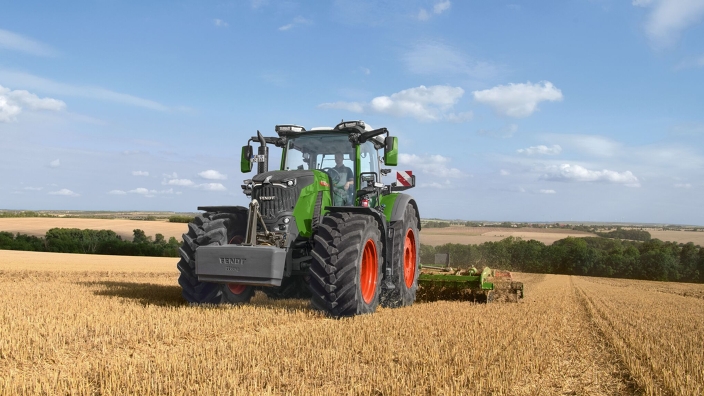
Fuel efficiency has always mattered on the farm, but with diesel prices climbing sharply in 2026, the amount of work a tractor can squeeze out of every gallon is becoming much harder to overlook. That makes the latest test results for Fendt’s new 832 Vario particularly timely.
The Fendt 832 Vario has set a new fuel-efficiency record in independent DLG PowerMix testing, averaging just 235 grams of diesel per kilowatt-hour (g/kWh), along with 29 g/kWh of AdBlue, or diesel exhaust fluid. According to Fendt, that is the lowest diesel consumption recorded among tractors up to 350 horsepower tested under the DLG PowerMix procedure.
The result comes as fuel has once again become a major operating-cost concern. According to the U.S. Energy Information Administration, the national average price for on-highway diesel reached $6.285 per gallon for the week of September 14, compared with $3.739 per gallon during the same period a year earlier. In the Midwest, diesel averaged $6.250 per gallon. For farmers putting hundreds of hours a year on high-horsepower tractors, efficiency differences that might have once looked relatively small can quickly translate into real money.
More Than a Lab Number
What makes the Fendt result particularly noteworthy is how the DLG PowerMix test works. The German Agricultural Society, or DLG, developed PowerMix to provide a standardized way of comparing tractor efficiency under workloads intended to more closely represent actual agricultural use.
The current test consists of 14 load cycles. Twelve simulate field operations involving draft, PTO and hydraulic loads, while another two simulate road transport, with every tractor subjected to the same standardized conditions. In other words, the 235 g/kWh figure isn’t simply the result of running an engine at its most favorable operating point.
During heavy towing work, the 832 Vario averaged about 243 g/kWh, while PTO work averaged 230 g/kWh and mixed work came in at 235 g/kWh, according to Fendt’s published PowerMix results. The tractor also performed particularly well in transport testing. At 60 km/h, or about 37 mph, the 832 recorded diesel consumption of 331 g/kWh, giving it the best result among tractors over 305 horsepower tested by DLG as of June 2026.
How Fendt Got There
The 832 Vario sits at the top of Fendt’s new 800 Vario series and uses a 7.9-liter, six-cylinder AGCO Power CORE80 engine. Maximum output is 343 PS, or 252 kW, while DLG testing measured maximum torque of 1,553 Nm at only 1,300 rpm.
Fendt credits the efficiency to more than the engine alone, pointing to the combination of the CORE80, its VarioDrive continuously variable transmission and the Fendt iD low-speed operating concept. Rather than relying on high engine speeds to produce usable power, the system is designed to generate high torque at relatively low rpm, while the continuously variable drivetrain manages ground speed and helps keep the engine in an efficient operating range.
There is also evidence that the result isn’t limited to the largest tractor in the series. The smaller Fendt 826 Vario averaged 239 g/kWh of diesel plus 29 g/kWh of AdBlue in PowerMix testing, only four grams per kilowatt-hour behind the record-setting 832. That suggests the efficiency gains extend more broadly across the new 800 Vario platform.
When a Gallon Saved Matters More
Specific fuel consumption figures such as g/kWh don’t translate neatly into gallons per hour because actual fuel use depends on how much power the tractor is producing and what work it is doing. But the economics behind improved efficiency aren’t complicated.
Consider a tractor that could save just one gallon of diesel per operating hour compared with another machine doing the same work. Over 800 hours, that’s 800 gallons of fuel. At $6 per gallon, the difference would amount to $4,800 in a single year.
The real-world difference between two tractors could be larger or smaller, and purchase price, maintenance, depreciation, resale value and DEF consumption all belong in the ownership-cost equation. Still, as diesel prices rise, fuel efficiency carries more weight in that calculation, especially for large tractors doing heavy tillage, planting or transport work that can consume thousands of gallons over a season.
Efficiency Becomes a Selling Point
For years, the high-horsepower tractor market has largely been a contest over power, traction, technology, operator comfort and, increasingly, automation. Fuel consumption never disappeared from the conversation, but inexpensive diesel made it easier for efficiency to take a back seat to productivity. That calculation changes when fuel prices climb.
Fendt Vice President of Marketing Roland Schmidt said the PowerMix result demonstrates the company’s focus on combining performance with efficiency, adding that with rising fuel prices, “every litre saved counts.” Manufacturers have plenty of incentive to make that case right now, and farmers comparing two similarly capable tractors increasingly have reason to look beyond horsepower and purchase price and ask how much fuel each machine requires to accomplish the same work.
The DLG PowerMix record doesn’t answer every part of that buying decision, nor does a standardized test perfectly replicate the conditions of every farm. But because competing tractors are tested using the same procedure, it provides something increasingly valuable: a consistent benchmark for comparing how efficiently tractors turn diesel into useful work.
At a time when every trip of the fuel truck costs considerably more than it did a year ago, the Fendt 832 Vario’s record couldn’t have arrived at a more relevant moment.


Leave a Reply