
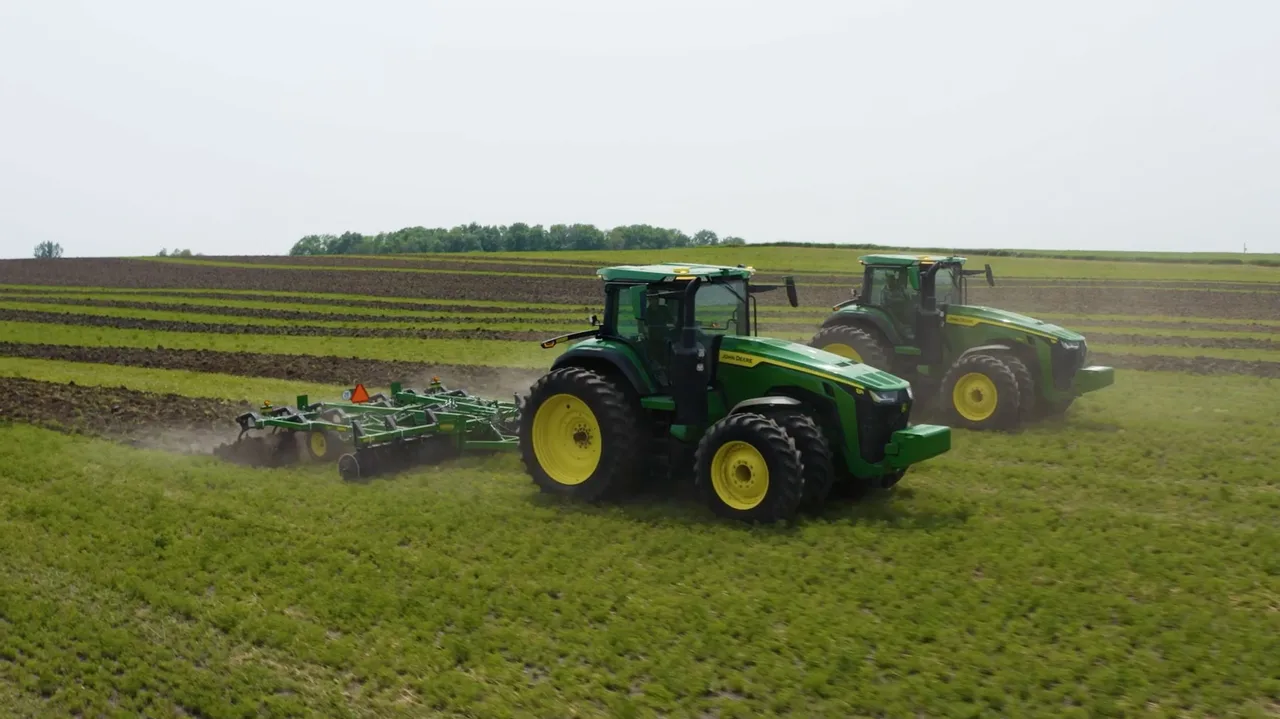
At first glance, there is little to distinguish John Deere’s experimental ethanol tractor from the familiar green-and-yellow 8R machines already working across farm country. It uses Deere’s 9.0-liter engine platform, produces the kind of power expected from a large row-crop tractor and has been put to work pulling grain carts and tillage equipment.
The difference is what goes into the tank. Instead of diesel, Deere’s prototype runs on E98, a fuel made up of roughly 98% ethanol. That means a tractor capable of doing some of the heaviest work on a farm can be powered primarily by a fuel made from one of America’s largest crops.
When Tractor Tuesday first covered Deere’s ethanol tractor in March, we looked at its potential to change how farmers fuel their operations. Six months later, Deere has expanded real-world testing while diesel prices have climbed sharply enough to put fuel costs back near the top of the list of concerns heading into fall fieldwork.
The national average price for on-highway diesel reached $6.529 per gallon on September 21, according to the U.S. Energy Information Administration. In the Midwest, it was even higher at $6.680. National diesel prices are now $2.78 per gallon higher than they were at this point last year.
Against that backdrop, a tractor powered by corn grown in the United States looks increasingly relevant.
From Prototype to Field Work
John Deere began developing its ethanol engine program in 2020. Rather than starting with an entirely new engine, engineers adapted the company’s established 9.0-liter platform to run on E98, with the goal of delivering the power and torque farmers expect from a diesel 8R.
According to Deere Director of Biofuels Nate Green, the target is “diesel-like power and torque.” Deere is now accumulating enough hours on the machines to find out whether it can deliver that outside the laboratory.
The company currently has four prototypes operating in the United States and another two in Brazil. Deere tested ethanol tractors in Iowa and Illinois last year, and additional machines are headed into Nebraska and Illinois fields this fall. One prototype recently worked 17-hour days during harvest in Kentucky.
That progression matters because Deere has acknowledged that it is showing the ethanol tractor to customers unusually early in development. These aren’t production machines with a launch date around the corner. They are working prototypes being used to determine whether the concept makes sense for farmers before Deere commits to manufacturing them at scale. So far, Green says the tractors have experienced some minor issues but are running well and doing real farm work.
Why Ethanol Looks Different With Diesel Above $6
Agriculture has become more productive, precise and technologically advanced, but high-horsepower farm equipment still overwhelmingly runs on diesel. That leaves farmers exposed to an energy market largely outside their control.
A producer can reduce idle time, eliminate unnecessary passes and carefully manage fuel consumption, but none of those things provide much protection from changes in crude oil prices, refinery economics or global distillate supplies.
Ethanol presents a different possibility because the United States already produces it at enormous scale from corn. That creates an unusual circular opportunity: corn can leave the farm for an ethanol plant, be converted into fuel and potentially return to agricultural communities as E98 capable of powering the machinery used to produce the next crop.
It is the idea behind the “Homegrown Horsepower” message surrounding Deere’s ethanol project. The National Corn Growers Association and state corn organizations have supported efforts to advance ethanol-powered agricultural equipment, including research and the fuel supply needed for testing. NCGA has also pointed to ethanol-powered machinery as an opportunity to create additional demand for ethanol and the corn used to produce it.
For corn growers, that makes Deere’s experiment interesting from both sides of the balance sheet. Ethanol could provide another fuel option when diesel becomes expensive while also creating another source of demand for their crop.
The No-DEF Advantage
There is another benefit farmers would notice immediately: an ethanol-powered 8R does not require diesel exhaust fluid.
Converting Deere’s 9.0-liter platform to ethanol involves changing it from compression ignition to spark ignition. Ethanol also produces far less particulate matter than diesel, changing what is required from the tractor’s emissions-control system. For farmers accustomed to diesel particulate filters, regeneration cycles and keeping another tank filled with DEF, simplifying that system has obvious appeal.
It also helps explain why Deere is interested in liquid renewable fuels rather than treating battery-electric power as the only path away from diesel. Large agricultural tractors present a particularly difficult electrification problem because they need to produce hundreds of horsepower for long periods, often during narrow planting and harvest windows when extended charging stops aren’t practical.
Liquid fuel already solves much of the storage and refueling problem. Farmers know how to transport it, store it and move it into a tractor quickly. Ethanol attempts to preserve those advantages while changing the source of the energy.
The Trade-Off: More Gallons
E98 isn’t a drop-in miracle fuel. Its biggest disadvantage becomes apparent when comparing the amount of energy contained in a gallon of ethanol with a gallon of diesel.
Deere says the tractor consumes approximately 1.72 gallons of ethanol for the equivalent of one gallon of diesel. The prototype has a 192-gallon fuel tank, which means an ethanol tractor working a long day could require a mid-day fill where a comparable diesel machine might keep running.
That makes the economics more complicated than comparing prices at the pump. If a tractor burns substantially more gallons of ethanol but those gallons are sufficiently cheaper than diesel, the economics can still work. If the price spread narrows, ethanol’s lower energy density becomes a much larger disadvantage.
For farmers, the figure that ultimately matters is the cost of accomplishing the work: dollars per hour, dollars per acre or dollars required to complete a particular job. With diesel currently above $6.50 nationally and approaching $6.70 in the Midwest, that calculation deserves considerably more attention than it did when petroleum-based fuel was cheaper.
The Bigger Challenge May Be Outside the Tractor
One of the largest obstacles to an ethanol tractor may have relatively little to do with the tractor itself. A commercial E98 machine would require dependable access to large quantities of high-concentration ethanol, along with compatible farm storage and delivery equipment.
Deere and corn grower organizations have already had to work on fuel logistics simply to keep the prototype fleet operating during field trials. The irony is that many of the farms where an ethanol tractor would make the most sense are surrounded by its feedstock and may be relatively close to ethanol plants. That doesn’t mean there is currently an established system for delivering E98 to farms in the quantities required to keep a 350-horsepower tractor working through a long harvest day.
That infrastructure would have to develop alongside the tractor. Deere also needs evidence that enough customers want the machine to justify investing in production. Green has said the company needs a clear demand signal before making that commitment, and current estimates still put potential commercialization roughly four to five years away.
Energy Independence at the Farm Gate
There is a tendency to look at alternative fuels primarily through the lens of emissions. Deere’s ethanol tractor raises another question that may resonate more directly with farmers right now: Where should the energy that powers American agriculture come from?
Ethanol won’t make an individual farm completely energy independent. Its price can fluctuate, its production requires energy and infrastructure, and farmers would still depend on processors and fuel distributors to turn corn into usable E98. But it could shift a larger portion of agriculture’s fuel supply toward an energy source produced domestically, much of it in the same rural communities where that energy is ultimately consumed.
The tractor itself still has plenty to prove. Deere is years away from a potential commercial launch, fuel infrastructure doesn’t yet exist at the necessary scale and ethanol’s lower energy density remains a real operational hurdle. But Deere has moved beyond simply proving that a large tractor can run on nearly pure ethanol. These machines are now pulling grain carts and tillage equipment through real fields.
The bigger question is whether the economics and infrastructure can catch up with the engineering. With diesel above $6 per gallon and Deere putting ethanol-powered tractors through long days in the field, “Homegrown Horsepower” is beginning to sound less like a slogan and more like a serious attempt to give American agriculture another option beyond diesel.


Leave a Reply