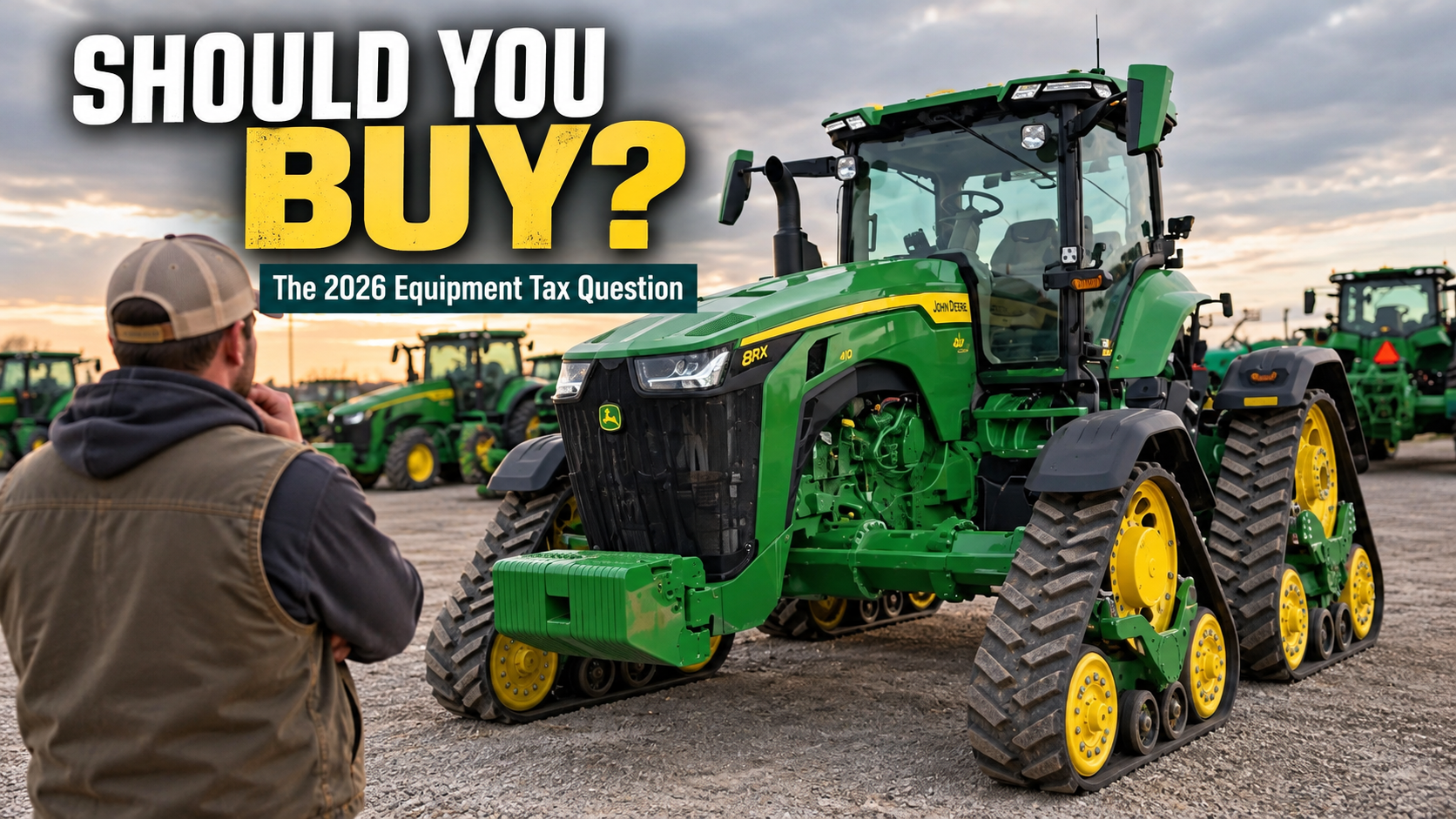
If you were lucky enough to make money farming in 2026, you’re getting close to the time of year when your accountant may start talking about ways to lower the tax bill. For a lot of farmers, that conversation eventually gets around to equipment.
Buying a tractor, combine or other piece of machinery before the end of the year can reduce taxable income, and the tax incentives for doing so are especially generous right now. But a tax deduction doesn’t make the equipment free. Buying a machine you don’t really need just to avoid sending money to the IRS can leave you with a smaller tax bill and a much bigger cash-flow problem.
There is also another option worth considering. For some operations, leasing equipment may make more sense than buying it.
The Tax Break Got Bigger
One of the biggest changes came through the One Big Beautiful Bill Act signed into law in 2025. The Section 179 deduction was increased to $2.5 million, allowing a business to deduct some or all of the cost of qualifying equipment in the year it is placed into service instead of depreciating that equipment over a number of years.
The law also permanently restored 100% bonus depreciation for qualifying property acquired after Jan. 19, 2025. That can allow the entire cost of qualifying new or used equipment to be deducted in the first year, giving farms that need equipment and have income to offset some substantial incentives to buy.
Successful Farming recently spoke with Barry Ward, director of Ohio State University’s Income Tax School, who pointed out another advantage of Section 179: farmers don’t necessarily have to expense the entire purchase. They can choose how much of a qualifying purchase to expense based on their tax situation.
In other words, buying a $250,000 tractor doesn’t necessarily mean taking a $250,000 deduction this year. That flexibility can help farmers balance their tax savings between years rather than simply trying to eliminate as much taxable income as possible in 2026.
A Tax Deduction Isn’t a Discount
This is where year-end equipment buying can get a little dangerous. Spending $200,000 to avoid paying taxes on $200,000 of income does not save you $200,000. It simply reduces the amount of income on which you owe taxes, while the money spent on the machine is still very real.
That can make perfect sense when the farm already needs a tractor, combine, planter or other piece of equipment. The tax deduction may make 2026 an especially attractive year to make a purchase that was coming anyway. It makes considerably less sense when the tax deduction becomes the primary reason for buying the machine.
Ward also cautioned farmers about protecting working capital heading into 2027. He noted that working capital has already eroded across parts of the crop sector and warned that next year’s margins could become more difficult depending on input costs. A new tractor might lower this year’s tax bill, but the payments and other ownership costs will still be there next year.
What About Leasing?
Farmers who need equipment but don’t want to commit as much capital to purchasing it have another option. DTN tax columnist Rod Mauszycki recently examined the growing interest in leasing farm equipment as producers deal with financial pressure, low commodity prices and high borrowing costs.
With a typical operating lease, a farmer makes payments to use the equipment for a set period and may have an opportunity to purchase it for its residual or fair market value at the end. Rather than purchasing the machine and potentially taking a large Section 179 or bonus depreciation deduction immediately, qualifying lease payments generally become deductible expenses over the term of the lease.
That could be attractive to a farm that needs a machine but would rather spread both the expense and the tax deductions across multiple years. Leasing can also reduce the amount of cash tied up in equipment, although whether it ultimately costs more or less than ownership depends heavily on the terms of the lease, financing costs, residual value and how long the farm intends to keep the machine.
There is an important tax catch, too. Calling an agreement a “lease” doesn’t necessarily make it one in the eyes of the IRS. Some arrangements can be treated as purchases, particularly when the terms effectively transfer ownership to the farmer. In that situation, the farmer generally depreciates the equipment rather than deducting the payments as rent, which is one reason to have a tax professional review the actual agreement before signing.
Or Maybe Don’t Do Anything
There is another option that doesn’t get advertised much at equipment dealerships in December: keep what you have. Farm equipment tax incentives are valuable because they can make a necessary investment less painful, but they aren’t a reason by themselves to make that investment.
If a tractor needs to be replaced, a combine is becoming unreliable or another machine would meaningfully improve the operation, the expanded Section 179 deduction and permanent 100% bonus depreciation can make purchasing particularly attractive. If preserving cash is more important, leasing might deserve a closer look. And if the equipment currently in the shed can reliably handle another season, paying some taxes and keeping the money may be the better business decision.
Every farm’s situation is different, and farmers should work with their tax professional before making a major year-end purchase. The expanded tax breaks give farmers more options in 2026, but the question shouldn’t simply be how much equipment you can write off.
Before buying another tractor to lower the tax bill, it may be worth asking a much simpler question: Do you actually need it?

Leave a Reply