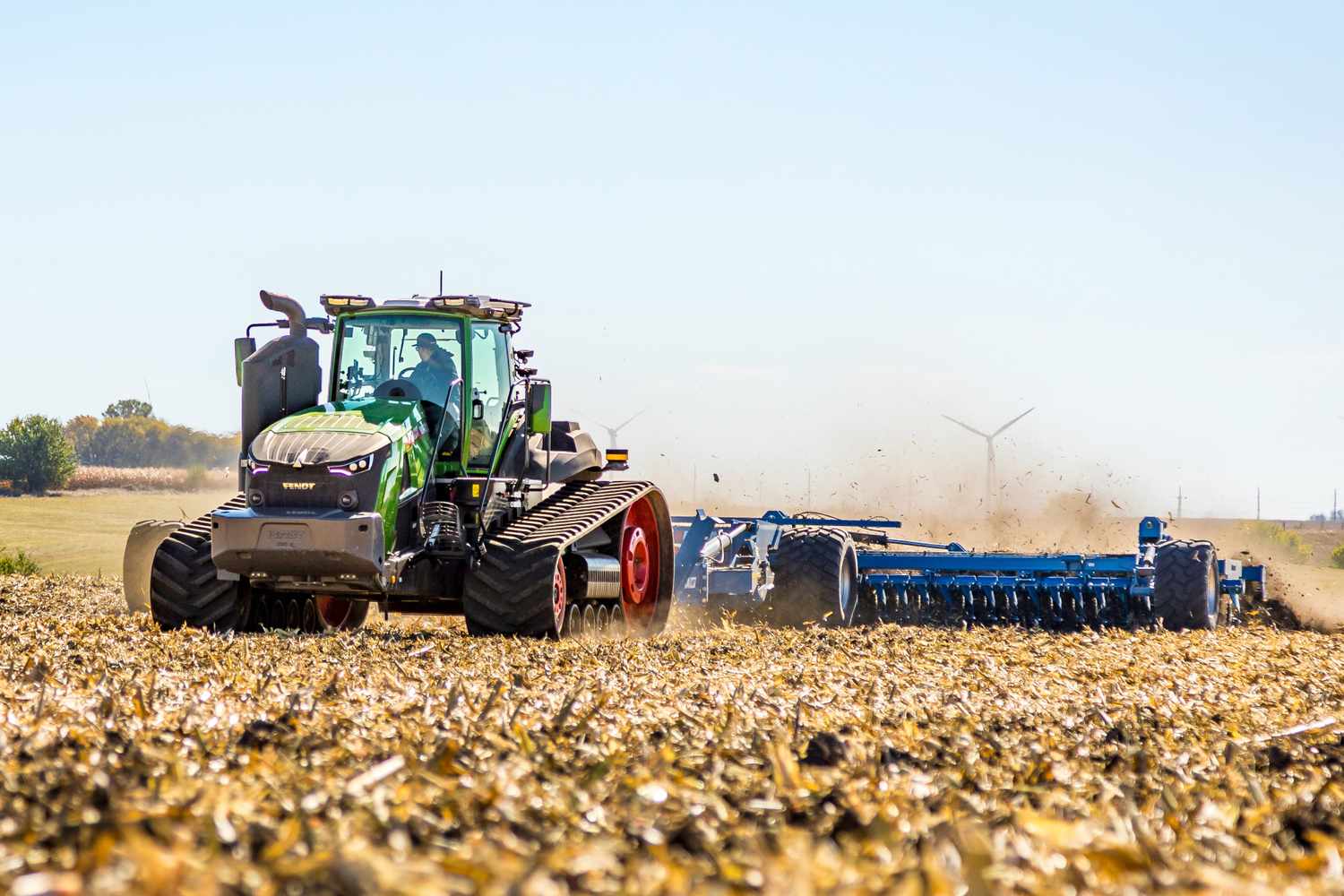
Fendt has spent decades building a reputation for premium tractors and advanced agricultural technology. Now, the German manufacturer is making an increasingly aggressive push into North America with larger equipment, an expanding product lineup and more opportunities for American farmers to see its machines at work.
The latest example is the new 1100 Vario MT Gen2, a tracked tractor producing up to 680 horsepower. The specifications are impressive, but Fendt faces a challenge horsepower alone cannot solve: convincing farmers to move away from brands they’ve trusted for generations.
A Bigger Tractor for a Bigger Market
Fendt unveiled its second-generation 1100 Vario MT at the 2026 Farm Progress Show in Boone, Iowa, marking the first time the company staged a global tractor launch in the United States.
The updated lineup includes four models ranging from 521 to 680 horsepower, with the flagship retaining Fendt’s claim to the world’s most powerful tracked tractor equipped with a continuously variable transmission. The new generation also features an upgraded VarioDrive transmission, improved suspension, a redesigned cab and the FendtONE operating system.
Fendt is emphasizing fuel efficiency, traction and operator comfort, particularly for large farms where machines spend long hours pulling heavy implements. The tractor is available to order, with initial deliveries expected in 2027.
The company also introduced its largest Momentum planter yet, an 80-foot, 32-row machine aimed squarely at large North American row-crop operations. Together, the launches show how seriously Fendt is targeting some of the biggest farms in the U.S. and Canada.
Taking the Technology Directly to Farmers
Fendt’s North American strategy extends beyond equipment launches and trade shows. This October, the company is conducting its 2026 Harvest Tour, visiting 11 farms across six Midwestern states and putting its IDEAL combine to work in actual harvesting conditions.
It’s a logical approach for a manufacturer trying to expand its presence in a competitive market. Farmers can compare specifications all day, but seeing a machine operate in familiar field conditions provides a different kind of proof.
The tour also gives Fendt an opportunity to demonstrate the technology central to its brand. Automated adjustments, connected systems and operator assistance are becoming increasingly important as manufacturers look for ways to increase productivity while reducing the demands placed on operators. Fendt’s challenge is showing that those features provide measurable benefits rather than simply adding complexity and cost.
Breaking Through Brand Loyalty
Fendt’s biggest obstacle in North America may have little to do with the performance of its equipment. John Deere and Case IH have spent generations establishing relationships with American farmers, and those relationships extend beyond the machines to local dealerships, service technicians, parts availability and familiarity.
When a tractor breaks down during planting or harvest, having a dependable dealership nearby can matter more than an impressive list of features.
Fendt has been working to strengthen that side of the equation. Parent company AGCO has reported significant expansion of Fendt dealer coverage in the Americas while the brand has gained ground in the North American large agricultural equipment market.
Still, expanding a dealer network and establishing customer confidence are two different things. Farmers considering a new brand must weigh purchase price, operating costs, resale value and whether qualified service will be available when they need it.
Fendt is trying to reduce some of that risk through its Gold Star Customer Care program. The new 1100 Vario MT, for example, includes three years or 3,000 hours of warranty coverage, scheduled maintenance, loaner availability and a parts guarantee.
Can Technology Change the Equation?
Fendt has long positioned itself as a premium equipment manufacturer, emphasizing efficiency, automation and operator comfort rather than competing primarily on purchase price. That strategy could become increasingly relevant as farms grow larger and labor becomes harder to find.
Features that reduce operator fatigue, simplify machine adjustments or improve fuel efficiency can translate into meaningful savings over thousands of operating hours. But the premium approach also creates a higher bar: farmers need to see enough financial or operational benefit to justify choosing Fendt over a familiar alternative.
The company’s growing lineup suggests it wants to compete across more of the farming operation, from planting and tillage to harvesting. Introducing major products in Iowa and then taking equipment directly to farms across the Midwest shows Fendt is also investing in the relationships needed to sell those machines.
The Next Challenge for Fendt
Fendt has already demonstrated that it can build powerful, technologically advanced equipment. The 680-horsepower 1100 Vario MT reinforces that reputation, while an expanding North American lineup gives farmers more reasons to consider the brand.
Turning that interest into lasting customers will be harder. Buying farm equipment isn’t just about horsepower or technology. It’s also about knowing who will answer the phone when something goes wrong, whether parts will arrive on time and what the machine will be worth when it’s time to trade.
Fendt appears determined to compete on all of those fronts. Whether premium technology, bigger equipment and stronger dealer support can overcome generations of brand loyalty remains to be seen.
The horsepower is already there. Now Fendt needs to earn the trust that goes with it.
Leave a Reply