
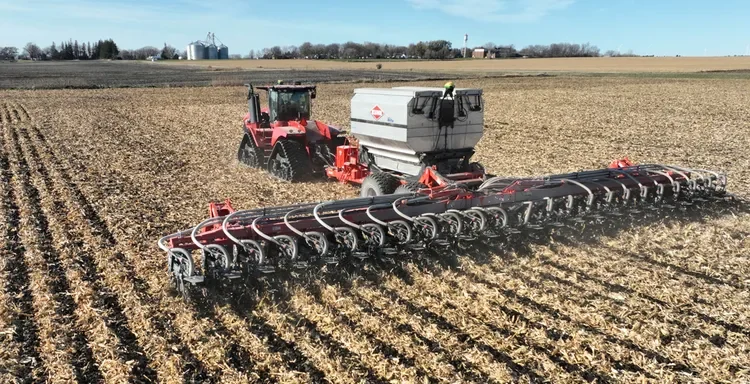
Tillage equipment isn’t always the flashiest part of a major farm show, but manufacturers gave farmers plenty to look at in 2026. Strip-till was particularly active, with new machines ranging from relatively conventional mounted toolbars to a 24-row system that can carry 16 tons of fertilizer and requires at least 650 horsepower.
The launches also showed just how broad the tillage market is becoming. Case IH is making a bigger push into strip-till, Kinze and Yetter are approaching the job more like planting, and autonomy is beginning to move beyond grain carts and into everyday fieldwork.
Case IH Gets Serious About Strip-Till
Case IH’s Nutri-Tiller 1000 Series brings the company’s soil-management lineup directly into strip-till. The lineup starts with the six-row rigid-mounted Nutri-Tiller 1010, while the folding Nutri-Tiller 1030 is available in eight-, 12- and now 16-row configurations.
Parallel-linkage row units are designed to maintain consistent depth, while residue management and berm conditioning help create a clean strip while leaving residue between the rows. Operators can control down pressure, residue managers, berm builders and strip keepers from the cab through ISOBUS controls.
Case IH also pairs the system with Active Implement Guidance, allowing the tractor and implement to follow the same guidance line independently. The objective is familiar to strip-till users: create a warmer, cleaner seedbed without disturbing the entire field, while potentially combining tillage and fertilizer placement into fewer passes.
Kinze and Yetter Build Strip-Till More Like a Planter
Kinze and Yetter took a somewhat different approach with the Falcon SF700 Strip Freshener, combining Kinze’s 5700 toolbar with Yetter’s 2984 Strip Freshener CC row units. One of the ideas behind the machine is to make strip preparation behave more like planting, with a toolbar that can flex 15 degrees up and down at each wing to follow changing terrain while weight transfer helps maintain consistent row-unit engagement.
The Falcon can run between 6 and 10 mph and is available in configurations ranging from 16 rows at 30-inch spacing to 36 rows at 20- or 22-inch spacing. Two 750-gallon tanks provide liquid fertilizer capacity, and horsepower requirements are listed at approximately 10 to 12 hp per row.
At a suggested retail price of about $280,000, it’s hardly a small investment. For operations already using precision guidance and trying to match tillage passes closely with the planter, however, the combination of speed, fertilizer capacity and planter-like terrain following makes for an interesting package.
Kuhn Takes Strip-Till to an Extreme
Kuhn’s Gladiator XL 1210 is difficult to ignore. The machine stretches strip-till to 24 rows, carries as much as 16 tons of fertilizer and requires at least 650 horsepower. Farm Progress estimates its price between $750,000 and $850,000.
That puts it well outside the needs of a typical operation, but it also demonstrates where large-scale strip-till is heading. Instead of treating tillage and fertility as separate jobs, machines like the Gladiator are becoming enormous one-pass field systems capable of covering substantial acreage while placing nutrients at the same time.
Kuhn is also pushing speed at the row-unit level. Its newer VT-PRO strip-till row unit is designed to operate at 7 to 10 mph, with in-cab adjustment of row cleaners and downforce and fertilizer placement between 2 and 5 inches deep.
Autonomy Moves Into Tillage
Some of the most interesting tillage technology at the show wasn’t another toolbar. PTx Trimble has expanded its OutRun autonomous system beyond grain-cart applications and into spring and fall tillage as well as land rolling. The system can operate with John Deere 8R and select Fendt tractors, with the operator able to monitor the machine through a mobile device.
Tillage could prove to be a particularly practical application for autonomy because it involves repetitive, time-consuming work that can keep a tractor and operator occupied for long days during narrow seasonal windows. If autonomous tractors can reliably handle those passes, the value may come as much from freeing up labor for other work as from changing the tillage operation itself.
John Deere is also expanding autonomy-ready capabilities within its tillage lineup while adding smaller High Speed Disk models in widths from 15 to 25 feet. Taken together, these developments suggest autonomous fieldwork is beginning to move from demonstrations toward a broader selection of everyday jobs.
Plenty of Conventional Iron, Too
Not every new machine needs autonomy or a massive fertilizer tank. Great Plains introduced its VT1200 Turbo Chisel with a floating hitch and multiple finishing options, while Norwood’s Kwik-Koulter high-speed disc harrow can operate between 10 and 15 mph and is offered in sizes reaching 60 feet wide.
Landoll’s 2700 VertiStrip emphasizes versatility instead, allowing farmers to configure the same toolbar with a shank, coulter or mole knife setup. Great Plains also showed the BD7510 drill, which can work at 20 feet wide but fold down to just 8 or 9 feet for road transport.
Why Strip-Till Is Getting So Much Attention
The amount of new strip-till equipment isn’t accidental. Farmers are looking for ways to reduce passes, protect residue, place fertilizer more precisely and control input costs without necessarily committing to a complete no-till system. Equipment manufacturers are responding with machines that increasingly combine several jobs, as tillage, residue management, fertilizer placement, guidance and even autonomous operation begin to converge.
The machines themselves range from relatively straightforward toolbars to an $850,000, 650-horsepower giant, but they point toward the same goal: disturb less of the field, make each pass accomplish more and put increasingly expensive inputs exactly where they’re needed.
For farmers evaluating new tillage equipment, the biggest question may no longer be simply how aggressively a machine works the ground. The better question is how many other jobs it can eliminate along the way.


Leave a Reply