
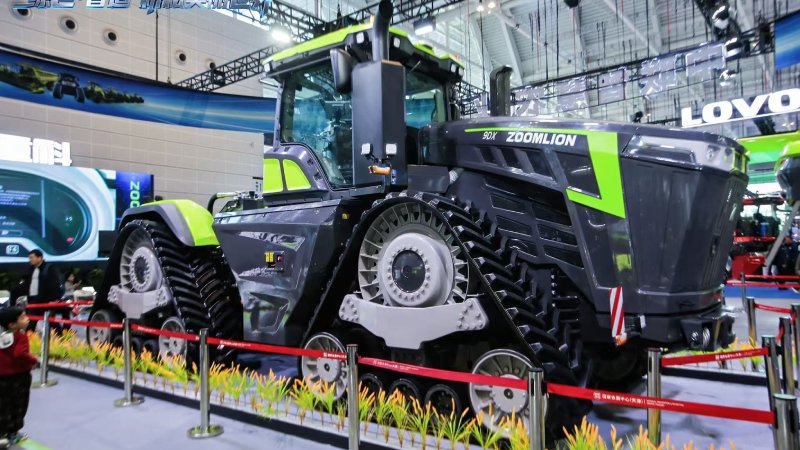
China’s Zoomlion has introduced what it calls the world’s most powerful agricultural tractor. With four tracks, an 800-volt hybrid drivetrain and nearly 170 gallons per minute of hydraulic flow, the 9DX pushes well beyond today’s conventional high-horsepower machines.
The horsepower race in agriculture just took an enormous leap. Chinese equipment manufacturer Zoomlion has unveiled a tractor claiming 1,600 horsepower, enough to make even the biggest John Deere and Case IH machines look modest on paper.
Introduced October 26 at the 2026 China International Agricultural Machinery Exhibition, the Zoomlion 9DX is a four-track hybrid tractor designed for massive tillage, seeding and other demanding field operations. The company is calling it the world’s most powerful agricultural tractor, although there’s an important distinction between its advertised peak horsepower and the ratings used for conventional diesel machines.
Still, the numbers are impressive, and the technology behind them may be more important than the horsepower record itself.
What Does a 1,600 HP Tractor Look Like?
The 9DX resembles the latest generation of articulated four-track tractors, but underneath its massive frame is an 800-volt hybrid drivetrain with two electric motors and a continuously variable transmission.
Rather than relying entirely on a conventional mechanical drivetrain, the hybrid system combines electrical power with sophisticated transmission controls to manage the enormous loads encountered when pulling heavy implements.
According to Zoomlion’s October 30 announcement, the company developed the chassis, major drivetrain components and electronic control systems in-house. The design is intended to improve power delivery, traction and operating efficiency during demanding fieldwork.
Here are the manufacturer’s headline specifications:
- Peak horsepower: 1,600 HP
- Peak torque: 7,200 Nm (approximately 5,310 lb-ft)
- Hybrid system: 800-volt dual-motor configuration
- Transmission: Hybrid continuously variable transmission
- Hydraulic capacity: 636 liters per minute (approximately 168 GPM)
- Undercarriage: Four rubber tracks, each 30 inches wide
The tractor also features a fully suspended cab with independent suspension, an important consideration for operators spending long days pulling equipment across rough ground.
How Does It Compare With John Deere and Case IH?
To put 1,600 horsepower into perspective, John Deere’s 9RX 830 delivers up to 913 maximum horsepower, while the Case IH Steiger 785 is rated at up to 853 maximum horsepower.
That puts Zoomlion’s advertised figure hundreds of horsepower above two of the most powerful mainstream agricultural tractors available in North America. But comparing these machines requires a closer look at how manufacturers measure horsepower.
Zoomlion’s 1,600 HP figure represents peak hybrid-system output, not necessarily the continuous horsepower available during a full day of heavy fieldwork. The company has not disclosed the diesel engine’s individual horsepower rating, the contribution of each electric motor, or the machine’s continuous rated output.
Those details matter when comparing a hybrid tractor with conventional diesel equipment. A machine capable of producing extraordinary power for short periods may perform differently when asked to pull a massive implement at full load for hours.
Until independent testing establishes sustained drawbar performance and fuel consumption, the 9DX’s headline horsepower should be treated as a manufacturer’s claim rather than proof that it can outperform every other tractor in the field.
Why Hybrid Power Makes Sense at This Size
Hybrid technology in agricultural equipment is sometimes associated with reducing emissions or fuel consumption. But in a tractor this large, the ability to manage torque and deliver power efficiently may be just as valuable.
Heavy tillage equipment creates constantly changing loads. Soil conditions, implement depth, hills and traction all affect how much power reaches the ground. A hybrid drivetrain can potentially respond to those changes more precisely than a conventional mechanical system, helping the tractor maintain performance without wasting as much energy.
Maintenance is another question. Hybrid systems introduce high-voltage components, power electronics and specialized controls that may reduce some mechanical complexity while creating new service requirements.
For farmers accustomed to maintaining conventional diesel tractors, long-term reliability and access to qualified technicians could be just as important as fuel savings. Any efficiency advantage would need to be weighed against the cost of purchasing, servicing and eventually repairing the hybrid components.
Nearly 170 Gallons Per Minute of Hydraulic Flow
One of the 9DX’s most interesting specifications has nothing to do with horsepower. Its hydraulic system delivers a claimed 636 liters per minute, or approximately 168 gallons per minute, an enormous amount of hydraulic capacity intended to support increasingly demanding implements.
Modern air seeders, variable-rate fertilizer applicators and other sophisticated equipment can require substantial hydraulic flow to operate fans, metering systems and other functions simultaneously.
A tractor with that much available hydraulic capacity could support larger and more complex implements without the same limitations that farmers encounter when pairing high-demand equipment with smaller tractors.
Of course, hydraulic flow alone doesn’t tell the whole story. Operating pressure, available hydraulic horsepower and the requirements of individual implements will determine what the system can actually accomplish.
Do Farmers Really Need 1,600 Horsepower?
That’s the question that makes this announcement interesting beyond the record-setting numbers.
Large farms have steadily moved toward wider implements and higher-horsepower tractors to cover more acres during increasingly narrow planting and tillage windows. More power can mean pulling a wider implement, maintaining field speed under difficult conditions or completing work with fewer passes.
But horsepower alone doesn’t guarantee greater productivity. At some point, traction, implement design, transport limitations, soil compaction and the logistics of operating enormous equipment become limiting factors. A tractor capable of producing 1,600 horsepower still needs an implement that can use that power efficiently.
Zoomlion’s four-track configuration is intended to distribute weight over a larger contact area, helping manage ground pressure. But without published operating weight, ground-pressure measurements and field performance data, it’s difficult to judge how the 9DX will perform across different soil conditions.
There is also the financial equation. A tractor this large would need to cover substantial acreage or deliver significant productivity gains to justify its purchase and operating costs. For most farms, a smaller machine with strong dealer support and predictable ownership costs may remain the more practical choice.
China’s Agricultural Equipment Industry Is Aiming Higher
The 9DX is also significant because of where it comes from.
Zoomlion is an established Chinese heavy-equipment manufacturer that has been expanding its agricultural machinery business, including hybrid tractors, harvesting equipment and precision farming technology. The 9DX represents another substantial step in the company’s efforts to compete in the high-horsepower agricultural machinery market.
The company’s ambitions extend well beyond China. Following the exhibition, Zoomlion hosted its 2027 Global Agricultural Machinery Dealer Conference, attended by more than 230 international partners. Representatives from over 20 countries, including Australia, Brazil, Egypt, Spain and Türkiye, signed commercial agreements.
That doesn’t mean American farmers will soon find a 9DX at their local dealership. Zoomlion has not announced a confirmed commercial production schedule, U.S. availability or pricing for the new tractor.
Even so, the announcement demonstrates that competition in high-horsepower agricultural equipment is becoming increasingly international, with manufacturers exploring alternative powertrains alongside conventional diesel technology.
The Real Test Will Happen in the Field
A 1,600-horsepower tractor makes for an impressive exhibition centerpiece, but farmers will ultimately judge the 9DX by more familiar standards.
How much fuel does it burn per acre? How much power can it sustain under a heavy load? Can it reliably pull wider equipment without creating additional problems? And who will service its hybrid drivetrain when something goes wrong?
Those questions remain unanswered, and they will matter far more to prospective buyers than the headline horsepower figure.
For now, Zoomlion has introduced one of the most ambitious agricultural tractor designs we’ve seen, combining an enormous claimed power output with hybrid technology and a hydraulic system built for exceptionally demanding implements.
Whether the 9DX becomes a practical tool for the world’s largest farms or remains primarily a demonstration of engineering capability will depend on what happens after the exhibition lights go out. Either way, it’s another sign that agricultural machinery manufacturers are looking well beyond the horsepower limits that once seemed unimaginable.

Leave a Reply