
CES 2026 has officially wrapped, and while consumer tech once again dominated the headlines, the most meaningful progress happened far from living rooms and gaming rigs. Agriculture quietly took a major step forward this year. What stood out was not experimental concepts or flashy demos, but real machines solving real problems. The conversation shifted from what might be possible someday to what is already being deployed in the field.
Two themes clearly defined this year’s show for agriculture. The first was Physical AI, where machines are no longer just automated but capable of reasoning and adapting in real time. The second was electrification for specialty crops, where precision and efficiency matter just as much as horsepower.
When Machines Start Making Decisions
The biggest shift at CES 2026 was the move beyond simple automation. For years, autonomy in agriculture meant following GPS guidance and repeating predefined tasks. This year, manufacturers showed machines that can understand their surroundings and make decisions on their own.
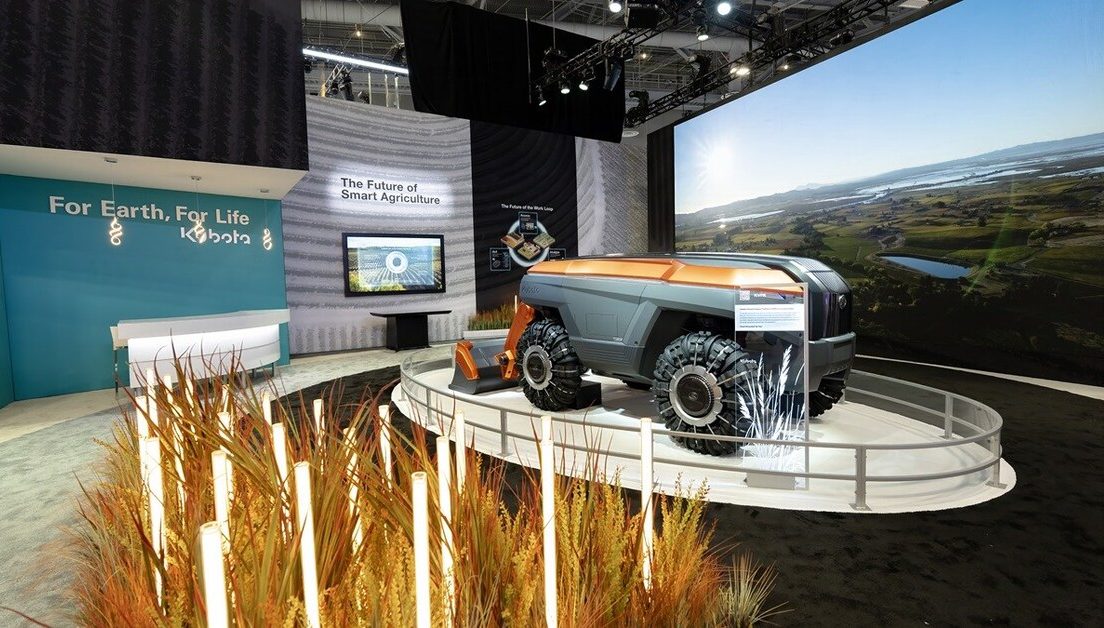
Kubota drew attention with its KVPR platform, a modular robotic system designed to physically adapt to different tasks, like a real Transformer. Instead of building a single-purpose machine, Kubota is envisioning a flexible robotic worker that can reconfigure itself depending on the job at hand. The real breakthrough is not the hardware, but the intelligence behind it. These machines are designed to assess conditions, select tools, and complete tasks without constant human direction.
John Deere addressed another long-standing challenge with its 5ML Orchard Tractor by focusing on environments where GPS struggles. Dense orchards and specialty crop operations often block satellite signals, limiting traditional autonomy. Deere’s automated orchard tractor relies on a sophisticated vision system combining multiple cameras and LiDAR sensors to create a three-dimensional understanding of its surroundings. The machine navigates, sprays, and operates with extreme accuracy, even when GPS is unavailable.
This approach signals an important shift. Autonomy is no longer tied to satellite guidance alone. Machines are learning to see, interpret, and respond to the physical world around them.
Electrification Moves From Talk to Traction
Electrification has been discussed for years, but it is becoming more obvious where it fits first. Specialty crop operations and mixed-use farm environments often benefit from smaller machines that run more hours in closer proximity to people, livestock, and sensitive plantings. Quiet operation, immediate torque, and smoother control are not just nice extras there. They can be real advantages.
That is why Deere’s E Power Prototype was one of the more interesting signals at CES. Instead of trying to electrify the biggest row-crop machines first, Deere showcased a battery-electric autonomous tractor concept aimed at vineyards and dairy settings. The point is not just emissions. It is control. Electric powertrains lend themselves to precise low-speed work, repeatable maneuvers, and less noise in environments where operators, workers, and livestock are nearby.
Deere’s X9 Shows Autonomy Is Not Just for Small Machines
While much of the CES conversation focused on compact and specialty equipment, Deere also used the show to reinforce that intelligence scales upward. The company highlighted its technology-loaded X9 combine as an example of how advanced automation is already delivering value in large-scale row-crop operations.
The X9 platform emphasizes throughput, efficiency, and operator confidence. Advanced sensing systems monitor crop flow, grain quality, and machine performance in real time. Automation adjusts settings on the fly to maintain peak efficiency, even as field conditions change. Rather than replacing the operator, the system reduces fatigue and guesswork, allowing a single machine to harvest more acres with greater consistency.
This matters because it shows that intelligent systems are not limited to futuristic concepts or niche applications. They are being integrated into high-horsepower machines that producers rely on every harvest season.
Eject Shot and the Shift to Per-Plant Decisions
One of the most important improvements in farm tech is happening in the “doing” part of the job, not just the driving. Smarter machines are starting to treat plants and field zones differently, rather than applying the same input everywhere.
That is where Eject Shot fits in. This technology is designed to identify targets and adjust application volumes in real time, plant by plant. Instead of spraying like you are painting a wall, it moves toward a model where the machine makes micro decisions based on what it sees. The impact is straightforward: reduced waste, more targeted chemistry or water use, and better efficiency when conditions are variable across a field or block.
This is a major mindset change. It turns application from a blunt instrument into something closer to a precision tool, and it makes autonomy more valuable because the machine is not simply following a route, but is actively managing the task while moving through it.
From Concept to Capability
CES 2026 made it clear that agriculture has moved past the phase of asking whether intelligent machines are possible. The focus is now on execution. Physical AI, vision-based autonomy, and electrification are no longer ideas on a whiteboard. They are showing up in equipment that producers can see, touch, and soon buy.
The future farm will still require experience, judgment, and human oversight. But increasingly, those humans will be managing systems rather than wrestling with machinery. The heavy lifting is being handed off to machines that can think, adapt, and improve with every pass through the field.
For an industry built on progress, this feels less like a distant future and more like the next logical step. And based on what CES 2026 showed, that step is already underway.


Leave a Reply