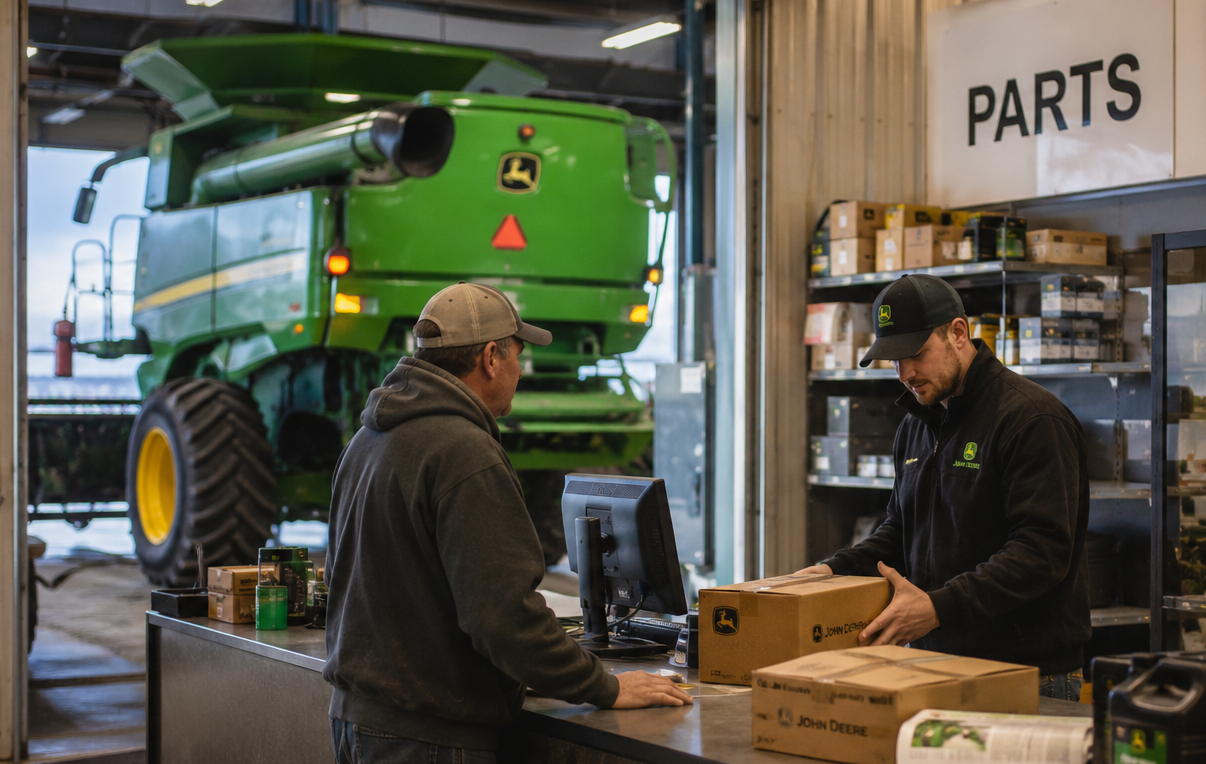
When most people think about investments from major farm equipment manufacturers, they picture new tractor platforms, larger combines, autonomous machines, or the latest precision ag technology. John Deere’s latest investment is different. Instead of unveiling another flagship machine, Deere is putting roughly $140 million into expanding and modernizing its parts distribution network.
At first glance, a parts warehouse story may not sound especially exciting. In reality, it says a lot about where the farm equipment industry is headed.
Modern agriculture has become increasingly dependent on uptime. Farmers are operating larger acres with tighter labor availability and narrower weather windows than ever before. As equipment becomes more advanced, the ability to quickly diagnose and source replacement parts has become nearly as important as the machine itself.
That appears to be exactly what Deere is trying to address.
Deere Is Investing in Response Time
The company recently highlighted major upgrades to its parts distribution operations, including investments in automation, forecasting systems, logistics coordination, and dealer support infrastructure. Deere says the goal is to move parts faster, predict demand more accurately, and improve availability across its dealer network.
This is not just about shelves full of filters and bearings anymore. Modern farm machinery now depends heavily on sensors, control modules, cameras, precision ag hardware, emissions systems, and software-integrated components. When one of those systems fails during a critical field window, speed matters.
The days of every farm stocking a massive inventory of spare parts in the shop have also changed. Equipment has become more specialized and technologically complex. Many repairs now require dealership diagnostics, software tools, and manufacturer-supported systems. That has increased the importance of dealer service departments and manufacturer logistics networks behind them.
In many ways, Deere is investing in something much larger than warehouses. The company is investing in response time.
The New Battle Is Uptime
That reflects a broader shift happening across agriculture equipment. The competitive battle is no longer based entirely on horsepower ratings or header widths. Manufacturers are increasingly competing on support ecosystems. Dealers, service trucks, software platforms, machine diagnostics, connected fleet management, and parts distribution are all becoming part of the ownership experience.
For farmers, that matters because downtime has become incredibly expensive. A delayed repair during harvest can affect grain quality, moisture levels, labor scheduling, trucking logistics, and overall harvest pace. During planting season, even a short delay can impact emergence timing and yield potential. Equipment reliability has always mattered, but the financial consequences of downtime have grown significantly as operations have scaled.
Why This Matters Right Now
The investment also comes during a softer period for new equipment sales. High interest rates, tighter margins, and elevated equipment prices have pushed many farmers toward holding machinery longer rather than trading frequently. That naturally increases demand for parts, repairs, and maintenance support.
Instead of focusing entirely on selling the next machine, Deere appears to be strengthening the infrastructure that keeps existing machines operating.
There is also a technology angle behind all of this. Deere has increasingly connected machines, dealer systems, and operations data through digital platforms like Operations Center. Modern forecasting systems can now help predict parts demand based on machine populations, seasonal trends, weather patterns, and regional equipment usage. In theory, manufacturers can position parts closer to where failures are most likely to occur before the farmer even calls the dealership.
That is a very different world from the traditional rural parts counter many farmers grew up with.
Deere’s latest investment highlights an important reality about modern agriculture. The most valuable machine on the farm is not always the newest tractor or combine. Sometimes it is the one that keeps running when conditions are perfect and the clock is ticking.
As equipment continues becoming more connected and technologically advanced, the companies that can keep farmers operating during critical field windows may end up with the biggest competitive advantage of all.

Leave a Reply