For many farmers today, the Steiger name is synonymous with Case IH. The green articulated tractors disappeared decades ago, and the red machines that carry the Steiger badge have become a familiar sight across North America. Yet long before the brand became part of a global equipment company, Steiger was one of agriculture’s most remarkable success stories.
Unlike many farm equipment manufacturers that began in factories or engineering firms, Steiger started on a farm. The company was founded because a family needed a larger tractor and discovered that nobody was building one.
That simple problem helped create one of the most influential tractor brands in modern agriculture.
A Tractor Built Out of Necessity
The story begins in the late 1950s near Red Lake Falls, Minnesota, where the Steiger family operated a large farming operation. Brothers Douglas and Maurice Steiger were farming thousands of acres and found themselves running into the limits of available equipment.
The tractors of the era were becoming larger, but not quickly enough for the scale of operation emerging across parts of the Upper Midwest and Canadian Prairies. The family wanted a machine capable of pulling larger implements and covering more ground with fewer passes.
Instead of waiting for manufacturers to build one, they decided to create their own.
In 1957, the Steigers assembled a massive four-wheel-drive articulated tractor using components sourced from military surplus equipment, truck parts, and industrial machinery. The homemade machine was powered by a Detroit Diesel engine and featured articulation that allowed the tractor to turn more easily than rigid-frame alternatives.
The tractor was painted green because that was the paint available at the local dealership. Nobody involved could have guessed that color would become one of the most recognizable identities in farm equipment history.
What began as a solution for one farm immediately attracted attention from neighboring producers. Farmers who saw the machine wanted one of their own. The Steigers suddenly found themselves in the tractor business.
Building the Articulated Tractor Market
Throughout the 1960s, Steiger refined its designs and began producing tractors commercially. The company’s timing proved ideal.
Farm sizes were increasing and implements were growing wider. Producers were looking for ways to improve productivity without adding more labor. The demand for high-horsepower four-wheel-drive tractors was accelerating, particularly across wheat-producing regions where large acreages rewarded larger equipment.
Steiger became one of the pioneers of the articulated tractor segment. Its machines offered substantial horsepower, impressive traction, and the ability to pull increasingly large tillage tools. At a time when many manufacturers were still focused primarily on row-crop tractors, Steiger concentrated on building large four-wheel-drive machines specifically for big-acre farming.
The Entrepreneurs Who Took Steiger National
While the Steiger family built the original tractor and laid the foundation for the company, the brand’s growth into a major agricultural manufacturer was also shaped by a group of North Dakota entrepreneurs who saw its potential.
In the late 1960s, Fargo businessmen Eugene Dahl and Les Melroe became involved with the company and helped provide the resources needed to expand production beyond its farm-built roots. Their leadership helped transform Steiger from a small tractor builder into a serious manufacturing operation serving farmers across North America.
One of the most significant milestones came when production was moved to Fargo, North Dakota. The company eventually developed a large manufacturing complex that allowed Steiger to increase output and meet growing demand during the horsepower race of the 1970s and early 1980s.
The Fargo years marked a turning point in Steiger’s history. While the company’s origins will always be tied to the Steiger family’s farm in Minnesota, the investment and business leadership provided by Dahl, Melroe, and others helped turn an innovative farm-built machine into one of the most recognized four-wheel-drive tractor brands in agriculture.
The Tractor Behind Several Brands
One of the lesser-known chapters in Steiger history is the role the company played in supplying tractors for other manufacturers. As demand for large four-wheel-drive tractors increased, several major brands turned to Steiger rather than developing their own machines from scratch. The Minnesota company produced tractors that were sold under multiple brand names.
Farmers could purchase essentially the same tractor painted in different colors and carrying different decals. Among the companies that partnered with Steiger were Ford, International Harvester, Massey Ferguson, and Allis-Chalmers. These arrangements allowed major manufacturers to quickly enter the high-horsepower four-wheel-drive market while leveraging Steiger’s expertise and production capacity.
For many years, some of the largest tractors carrying familiar industry names were actually built by Steiger. The partnerships also helped cement Steiger’s reputation as one of the leading engineering and manufacturing organizations in the agricultural equipment industry.
The Tiger Era
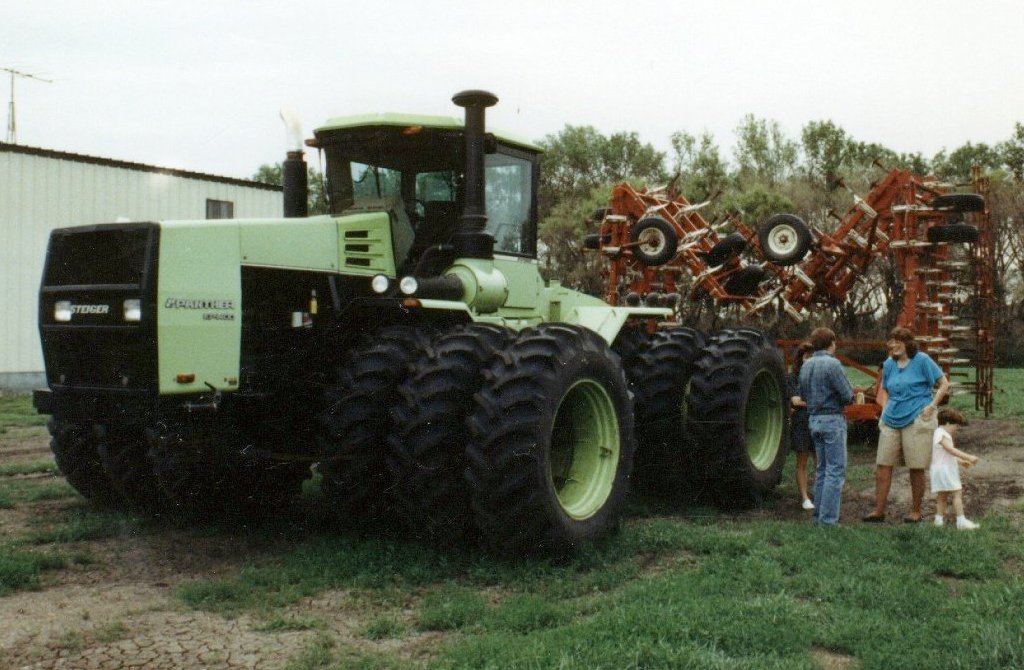
By the late 1970s and early 1980s, Steiger was producing some of the largest and most recognizable tractors in agriculture. Models such as the Panther, Cougar, Bearcat, and Tiger became legendary among producers who needed serious horsepower. The company embraced animal-themed names that matched the size and capability of its machines.
The Tiger series, in particular, became one of the defining tractors of the era. These machines represented the growing trend toward larger farms and higher horsepower requirements. For many producers, owning a Steiger was a statement that their operation had reached a new level of scale.
The green articulated tractors became icons of Prairie agriculture and remain highly sought after by collectors today.
The Agricultural Downturn
Like much of the farm equipment industry, Steiger faced significant challenges during the agricultural downturn of the 1980s. High interest rates, falling commodity prices, and financial stress throughout the farm economy created difficult conditions for equipment manufacturers. Demand for large tractors declined sharply as farmers delayed purchases and focused on managing costs.
The environment became increasingly difficult for independent manufacturers. Despite its strong reputation and loyal customer base, Steiger found itself operating in an industry that was rapidly consolidating. Larger corporations possessed greater financial resources and broader product portfolios that helped them weather economic uncertainty.
The company needed a partner with the scale to compete in a changing marketplace.
The Case IH Acquisition
In 1986, Steiger was acquired by Tenneco, the parent company of International Harvester’s agricultural business, which would soon become Case IH. The acquisition brought one of agriculture’s most respected four-wheel-drive tractor brands into a much larger organization.
Unlike many acquisitions that erase a company’s identity, the Steiger name survived. Case IH recognized the value of the brand and the loyalty it commanded among farmers. Over time, the green paint disappeared and the tractors adopted Case IH’s familiar red appearance, but the Steiger name remained attached to the company’s flagship articulated tractors.
Today, the Steiger badge continues to appear on some of the most powerful tractors in the industry.
A Legacy That Still Shapes Modern Farming
More than six decades after the Steiger family built their first homemade tractor, the company’s influence remains visible across modern agriculture. The articulated four-wheel-drive concept that Steiger helped popularize became the standard for high-horsepower tractors. Nearly every major manufacturer now offers machines that trace their lineage to ideas pioneered by companies like Steiger.
The brand’s story also serves as a reminder that many of agriculture’s most important innovations began with farmers solving practical problems. The Steiger family was not trying to launch a global equipment company. They simply needed a bigger tractor. That need led to a machine that transformed an industry, built one of the most respected names in farm equipment, and created a legacy that still rolls across fields today under the familiar red colors of Case IH.
Editor’s Note: After publication, we received valuable feedback from reader Ed Melroe regarding Steiger’s growth from a farm-built tractor company into a major manufacturer. Ed noted the important contributions of Les Melroe, Eugene Dahl, and the company’s expansion into Fargo, North Dakota, where large-scale manufacturing helped establish Steiger as a leading force in the four-wheel-drive tractor market. We appreciate Ed’s contribution and have updated this article to better reflect that chapter of Steiger’s history



Leave a Reply