
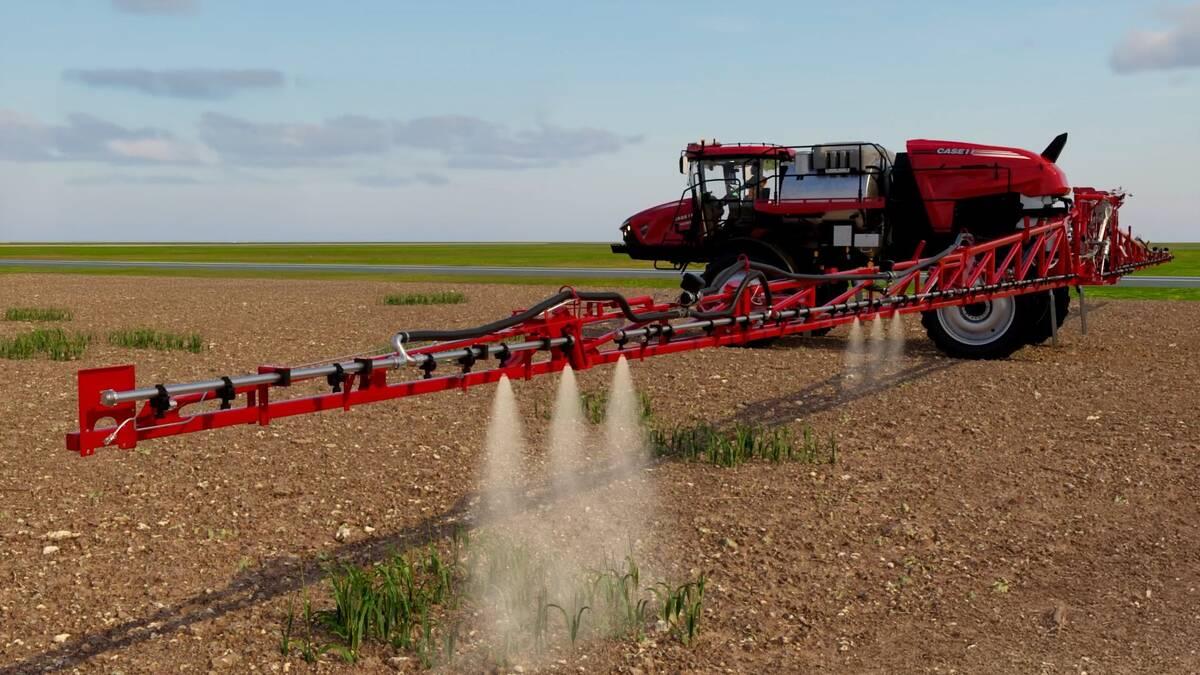
For years, smart spraying has promised a fairly simple improvement to crop protection: use cameras and computers to identify weeds, then apply herbicide only where it is needed. Farmers are increasingly putting that idea to work.
John Deere says use of its See & Spray technology has grown significantly year over year, with customers achieving more than 50% savings on herbicide. During Deere’s third-quarter earnings call, Deanna Kovar, president of Worldwide Agriculture & Turf, said early orders indicate factory adoption of See & Spray could nearly double. Roughly one-third of North American sprayers currently on early order are being configured with the technology.
Those numbers suggest camera-based spraying is starting to move beyond early adopters.
Treating Weeds Instead of Acres
A conventional broadcast application generally treats the entire width of the sprayer at a predetermined rate. Smart spraying adds cameras, sensors and onboard processing that can evaluate conditions as the machine moves through the field.
Depending on the system, cameras can identify vegetation, distinguish weeds from crops or measure differences in crop health. Individual nozzles or sections of the boom can then respond in real time.
The savings can be substantial when weeds are scattered across a field. Instead of applying the same amount of herbicide everywhere, the sprayer treats the areas where the application is actually needed.
Research published in 2026 examining real-world See & Spray use found that producers covered more than 1.26 million acres with the technology during 2023 and 2024 while spraying roughly 524,000 acres. The economics varied considerably depending on weed pressure, crop, settings and herbicide costs, but the study illustrates how dramatically targeted spraying can reduce treated acres under the right conditions.
That can become particularly valuable as chemical costs rise or farmers turn to more expensive herbicides to manage resistant weeds.
Deere Has Plenty of Company
See & Spray may be the most recognizable smart-spraying system in North America, but manufacturers and technology companies are approaching the same problem in several different ways.
Case IH offers SenseApply technology on Patriot sprayers and Trident combination applicators. A cab-mounted multispectral camera detects vegetation and can adjust application rates across the boom while the machine travels through the field. Its Selective Spray function can detect weeds in bare or residue-covered fields and activate the appropriate nozzles as the sprayer passes.
Case IH also promotes SenseApply without annual subscription or per-acre fees. The company estimates the technology can potentially pay for itself within one to two years, depending on acres, applications and how it is used.
Precision Planting, part of AGCO’s PTx portfolio, offers another approach with SymphonyVision | Duo. The retrofit system combines cameras with separate nozzle systems, allowing a farmer to broadcast a primary tank mix while simultaneously spot-applying another product where cameras identify weeds.
That gives farmers the ability to broadcast residual chemistry while reserving more expensive contact herbicides for identified weeds. Because the technology can be added to existing equipment, farmers can also move into targeted spraying without waiting to replace the entire sprayer.
Greeneye Technology is pursuing a similar retrofit strategy. Its camera-based system can be installed on existing sprayers and uses artificial intelligence to identify weeds and trigger individual nozzles. Greeneye reported average reductions of 87% in non-residual herbicide use during 2024, although actual savings depend heavily on field conditions and weed pressure.
Bosch and BASF are also developing One Smart Spray, which uses cameras and machine-learning algorithms to identify weeds within growing crops. The technology is designed to integrate with machinery from multiple manufacturers, adding another major competitor to a rapidly developing category.
The systems vary in how they identify plants, control nozzles and fit onto equipment, but they are all pushing chemical application toward much more precise treatment.
The Economics Go Beyond Herbicide Savings
Chemical savings are the easiest benefit to measure. If a sprayer travels across 1,000 acres but only needs to apply a particular herbicide across 400 of them, the reduction in product is immediately visible.
The economics become even more interesting with expensive chemistry.
A herbicide that is difficult to justify as a full-field broadcast treatment may be much easier to pencil out when it is applied only to identified weeds. That could give farmers more flexibility in choosing modes of action and managing herbicide-resistant weeds.
Using less product can also extend the distance a sprayer travels between refills. During a narrow application window, fewer stops for water and chemical can translate into more acres covered each day.
Smart sprayers can collect useful information at the same time. Deere’s system, for example, can generate weed-pressure and as-applied maps as it travels through the field. Similar capabilities are being developed across the industry.
That turns every spraying pass into another opportunity to scout the field and document where weed pressure is occurring. Over time, those maps could help farmers evaluate problem areas, adjust future herbicide programs and better understand how weed populations are changing.
Retrofit Systems Could Open the Door
The ability to add smart-spraying technology to existing equipment could significantly expand the market.
Factory-installed systems make sense for farmers already planning to replace a sprayer. Retrofit products from companies such as Precision Planting and Greeneye can reach machines that may otherwise remain in service for years.
That matters in agriculture, where major equipment replacement cycles can be long. A farmer who bought a late-model sprayer a few years ago may have little interest in trading it simply to gain access to camera-based spraying. A retrofit option changes that calculation.
There are still practical and financial limitations. Cameras, processors and nozzle-control systems add cost and complexity. Weed density matters, and savings can shrink considerably in fields where most of the acre needs treatment anyway. Herbicide prices also influence how quickly the technology pays for itself.
Those variables make smart spraying easier to justify on some farms than others.
What farmers can measure after each application is much simpler: acres covered, acres actually treated, gallons applied and chemical saved. Deere’s recent adoption figures suggest that calculation is working for a growing number of operations.
Competition should also push the technology forward. Deere, Case IH, AGCO’s Precision Planting, Greeneye, Bosch, BASF and others are investing in systems that can make spraying decisions at increasingly smaller scales and higher speeds.
Smart spraying still has plenty of room to develop, but it is becoming easier for farmers to buy, retrofit and evaluate in real-world conditions. As more of these systems reach the field, applying the same rate across every square foot of an acre may increasingly feel like a wasteful way to spray.


Leave a Reply