
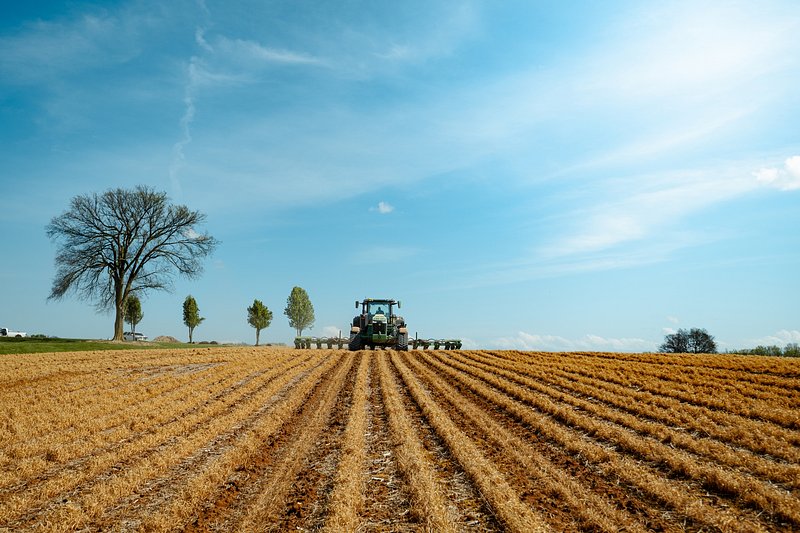
Anyone looking for signs that strip-till is becoming a bigger part of the farm equipment industry didn’t have to look very hard at the 2026 Farm Progress Show.
The show’s official program listed 24 companies in its strip-till category, ranging from established names like Kuhn Krause, Unverferth and Environmental Tillage Systems to a growing collection of manufacturers offering toolbars, row units, fertilizer systems and other components. Several used the show to publicly debut new equipment.
Noah Newman of No-Till Farmer, who spent the rain-shortened show visiting manufacturers and looking at new strip-till equipment, summed up his first impression simply: “Man, this Strip-Till Section just keeps getting bigger and bigger every year.”
What manufacturers brought to Boone may be even more telling than the number of companies exhibiting. New machines addressed some of the biggest practical considerations surrounding strip-till, including fall and spring flexibility, fertilizer capacity, residue management, narrower row spacing and the cost of getting started.
One Machine for Fall or Spring
Yetter Farm Equipment used the show to introduce its new 9000 Rebel, a strip-till machine designed to operate with either a coulter attachment or knife configuration. The idea is to give farmers more flexibility to change how and when they build strips without requiring a completely different machine.
“If adapting to weather and shifting management practices requires two machines or excess time, it’s a barrier for growers,” Yetter strip-till product director Andy Thompson told No-Till Farmer.
The Rebel can be configured for shallower coulter-based tillage or deeper knife operation. According to Successful Farming, the coulter configuration operates from approximately 1½ to 4 inches deep, while the knife can work from 5 to 8 inches. The machine also offers in-cab adjustments and multiple fertilizer configurations.
That versatility could become increasingly important in a system where weather often determines whether a farmer gets the opportunity to make strips in the fall or has to wait until spring. Rather than designing equipment around one narrow operating window, manufacturers are giving farmers more options to adapt the machine to conditions.
Montag showed a similar emphasis on flexibility with a new toolbar designed to accommodate different strip-till row units. Farmers can work with dealers to configure the toolbar around the type of row unit and fertilizer system that fits their operation instead of being locked into a single setup.
Strip-Till Goes Big
At the other end of the spectrum, some of the newest equipment at Farm Progress Show demonstrated just how large strip-till machines are becoming.
Kuhn Krause displayed its new 24-row 1210 Gladiator XL for the first time. The 60-foot machine increases dry fertilizer capacity, targeting large-acreage farms and custom operators where stopping to refill can become a significant productivity bottleneck.
“With this new machine, we’ve increased our fertilizer capacity from 9 tons to 16 tons,” Kuhn Krause product manager Michael Berggren told No-Till Farmer. “Designed for high acres and custom operators, this allows you to keep running with less downtime.”
Environmental Tillage Systems also showed a 60-foot, 24-row SoilWarrior. Despite doubling the number of rows compared with some configurations, the new machine uses a narrow-fold design intended to keep transport width similar to the company’s existing 12- and 16-row machines.
The new SoilWarrior also incorporates updated EdgeVantage row units and individual-row fertilizer flow monitoring. The latter gives operators real-time information to confirm fertilizer is being delivered correctly across the entire toolbar.
These aren’t small experimental machines aimed at a niche corner of an operation. Sixty-foot implements with large fertilizer capacities and individual-row monitoring are being designed to cover serious acres.
Tackling Residue and Narrower Rows
Lynx approached another challenge: making strip-till work in heavy residue and narrower row configurations.
The company’s prototype Empire 24-row toolbar was designed in response to feedback from farmers dealing with corn-on-corn residue and growers interested in moving from traditional 30-inch rows to 20-inch spacing.
“One thing we always hear from farmers is that they love strip-till and they’re doing a lot of corn on corn, but their issue is flowing residue through the row unit in the fall and constantly struggling with that,” Lynx national sales manager AJ Adkins told No-Till Farmer.
The 24-row Empire prototype was built around those concerns, particularly moving residue through the machine without plugging in 20-inch rows. Lynx also introduced its DK-1000 coulter-only row unit for 2026, rated for field speeds up to 10 mph with lower horsepower requirements than its traditional shank-style equipment.
That development illustrates another direction manufacturers are taking. Instead of expecting farmers to change their cropping system to accommodate strip-till equipment, companies are increasingly designing machines around the cropping systems farmers already want to use.
Fertilizer Placement Remains a Big Part of the Equation
Reducing tillage is only part of strip-till’s appeal. The ability to place fertilizer precisely within the root zone remains another major reason farmers consider the practice, particularly when fertilizer prices make efficiency increasingly important.
Longtime no-tiller Marion Calmer discussed his use of an Unverferth Raptor at the show, explaining that he uses the strip-till bar to place phosphorus and potassium deeper in the soil profile rather than relying entirely on surface broadcasting.
“We need to put the fertilizer back from where we took it,” Calmer told No-Till Farmer.
That ability to combine tillage and nutrient placement helps explain why so much of the new equipment integrates increasingly sophisticated fertilizer systems. Strip-till can allow a farmer to prepare the future seed zone while placing nutrients where the crop can access them, potentially reducing trips across the field and making more targeted use of expensive inputs.
A Simpler Way In
Not every new machine at Farm Progress Show was about adding rows, capacity or technology.
Dalton AG debuted its RTZ Strata Series with a different objective: provide a simpler and potentially more economical way for farmers to enter strip-till. The machine uses a modular row-unit design that allows buyers to add or change components such as row cleaners, baskets and sealers.
Dalton AG sales manager Andy Brammer described it as “a concept of simpler strip-till,” with several configurations available so growers aren’t committed to one setup.
Test units are expected to run this fall, with some commercial availability planned for spring and full production targeted ahead of fall 2027.
That approach may prove just as important to the growth of strip-till as the massive 24-row machines. A farmer considering strip-till for the first time has a very different set of equipment needs than a large operation or custom applicator trying to cover thousands of acres.
More Choices for Farmers
Taken together, the equipment displayed at Farm Progress Show suggests strip-till is maturing into a much broader machinery category.
Manufacturers are attacking the limitations from several directions at once. Some are building wider machines with substantially more fertilizer capacity. Others are developing equipment that can switch between fall and spring configurations, handle heavy residue, accommodate 20-inch rows or give farmers a less expensive starting point.
The official Farm Progress Show field demonstration lineup reinforced that trend, with strip-till equipment from companies including AgSynergy, Case IH, Lynx and Environmental Tillage Systems among the machines highlighted for attendees.
None of that means strip-till is suddenly the right answer for every farm. Soil type, crop rotation, climate, fertilizer program, horsepower and existing equipment all factor into whether the economics make sense.
But 24 companies showing strip-till products at one of America’s biggest farm shows is difficult to dismiss as a niche equipment trend. The machines are getting bigger, the configurations are getting more flexible and farmers have more choices than they did even a few years ago.
For producers already using strip-till, that competition should mean better equipment and more options. For those who have been interested but couldn’t make the machinery, timing or economics work, the industry’s next generation of strip-till equipment may make the calculation worth revisiting.
Source: Reporting and manufacturer interviews from Noah Newman of No-Till Farmer’s “5 Big Strip-Till Takeaways from 2026 Farm Progress Show,” along with Farm Progress Show and Successful Farming equipment information.


Leave a Reply