Precision agriculture has transformed planting, spraying and grain harvest, but CNH is increasingly bringing that same level of field intelligence into hay and forage equipment.
Recent introductions from Case IH and New Holland show a common direction. New windrowers can map relative crop yield as they cut, while an AI-powered camera on New Holland forage harvesters can evaluate kernel processing in real time and automatically help adjust the machine. Across both brands, CNH is turning equipment that traditionally focused on cutting and processing crop into another source of agronomic data.
The common link is FieldOps, CNH’s digital platform, where much of that information can be stored, mapped and reviewed after the machine leaves the field.
Case IH Maps Yield While Cutting
The new Case IH WD6 Series windrower brings relative yield mapping into hay and forage harvest. Rather than requiring a separate pass or relying solely on observations from the cab, operators can see relative variations in crop yield across a field while the windrower is working.
The resulting map can be viewed through FieldOps, giving producers a record of how forage production varied throughout the field. Case IH says that information can provide agronomic insights that producers can compare from year to year, and connectivity to FieldOps is included without an annual subscription.
That makes the windrower more than a machine for putting crop on the ground. The data gathered during cutting could help identify consistently strong or weak areas of a field and provide another layer of information for future management decisions.
Case IH has also upgraded the iron around the technology. The WD6 can cut at speeds up to 20 mph and travel between fields at up to 30 mph, while an active hydraulic flotation system automatically maintains pressure to help produce a more consistent cut.
New Holland Is Taking a Similar Approach
Case IH isn’t alone within CNH. New Holland introduced its Speedrower 1 Series earlier this summer with its own Relative Yield Monitoring system connected to FieldOps.
The four-model lineup ranges from 161 to 308 peak horsepower, but one of its more significant changes may be what the machine records while covering those acres. Relative Yield Monitoring creates maps showing crop variability in real time, allowing an operator to react to changing conditions during harvest and preserve the information for later analysis.
New Holland says operators could use that information immediately, such as adjusting ground speed in lighter crop or managing cut quality through heavier forage. Once stored in FieldOps, the same data can be compared across fields and seasons and potentially used to inform irrigation, nutrient management, pest scouting and zone-based soil sampling. FieldOps connectivity is included for the life of the machine without a recurring subscription.
Like the Case IH WD6, the Speedrower also combines its precision upgrades with greater machine capability. The new lineup can reach 20 mph in the field and 30 mph on the road, while the largest Speedrower 301 offers 308 peak horsepower. New Holland also added a larger fuel tank, redesigned cooling system and AutoFloat header flotation technology.
The similarities between the Case IH and New Holland systems are notable. Under both brands, CNH is effectively turning mowing into another opportunity to collect useful field information.
ForageCam Goes Beyond Mapping
New Holland’s new ForageCam takes that concept a step further by moving from measuring where crop performance varies to evaluating what is actually happening to the crop inside the machine.
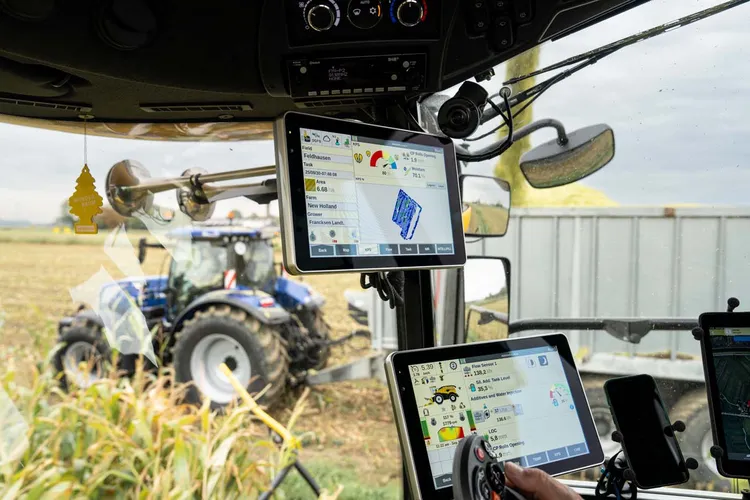
Available for New Holland’s 2027 FR Forage Cruiser lineup, ForageCam uses an AI-powered camera mounted on the spout to continuously analyze chopped corn as it passes through the harvester. The system looks at the percentage of fully processed kernels and compares the results against a kernel processing score, or KPS, selected by the operator.
Traditionally, checking kernel processing quality could involve using a shaker box or collecting samples for laboratory analysis. Those methods still have value, particularly laboratory testing, but they provide a sample rather than a continuous view of what is happening during harvest.
ForageCam analyzes the crop several times per second and displays the resulting KPS to the operator. More significantly, the information can be used to automatically adjust the kernel processor to help maintain the desired forage quality. New Holland says those adjustments can help avoid underprocessing while also improving throughput, reducing unnecessary fuel consumption and limiting machine wear.
That matters because simply processing corn more aggressively isn’t necessarily better. If the machine can determine that the desired processing score is already being achieved, the processor gap may be adjusted rather than consuming additional fuel and wearing components simply to provide an extra margin of safety.
Operators can also select a desired KPS based on the type of livestock being fed. ForageCam data can be viewed live through the IntelliView IV Plus display, while KPS monitoring and mapping information can later be reviewed through FieldOps.
New Holland says ForageCam can be ordered for the 2027 season, with a retrofit kit planned for existing FR forage harvesters.
The Machine Is Starting to Watch the Crop
Taken separately, these developments could look like another round of technology upgrades to individual machines. Together, they reveal a broader direction for CNH’s hay and forage equipment.
The Case IH WD6 and New Holland Speedrower are collecting information about crop variability as they move through the field. ForageCam moves further into crop-quality monitoring, using computer vision to evaluate how effectively corn is being processed and allowing the machine to respond to what it sees.
FieldOps then gives those machines a common destination for the information they collect.
That represents an important evolution in precision agriculture. For years, much of the technology added to farm machinery focused on the machine itself: guidance, fuel consumption, location, productivity and operating parameters. CNH’s latest hay and forage technology increasingly asks the machine to observe the crop, too.
A windrower can begin telling a producer where forage production changes across a field. A forage harvester can determine whether kernels are being adequately processed as crop passes through the spout. The resulting information can then become another layer producers use to make decisions during harvest and long after it is over.
For hay and forage producers, some of the most important technology on the next generation of equipment may not simply help the machine cut faster or process more tons per hour. It may help the machine understand what it’s harvesting.

Leave a Reply