
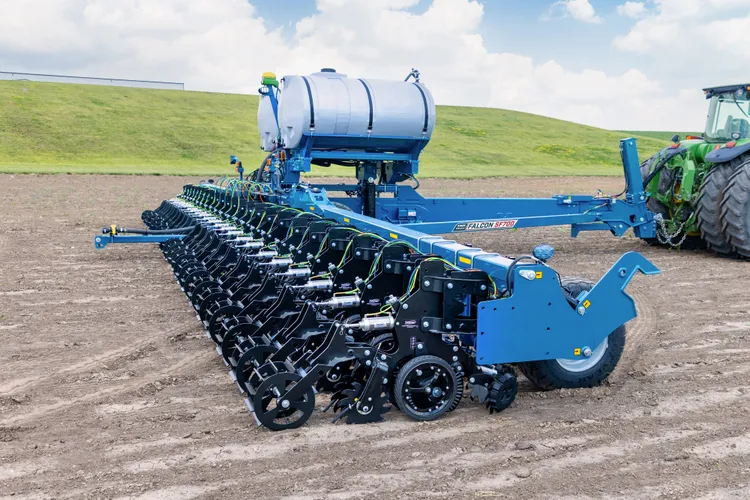
The Falcon SF700 may look like another addition to the strip-till market, but the partnership behind it makes this a big story.
Instead of designing an entirely new strip-till system from the ground up, Kinze and Yetter each brought what they already do best. Kinze contributed its proven 5700 planter toolbar platform, while Yetter supplied its long-established 2984 Strip Freshener row units and decades of strip-till experience. The result is a machine that feels less like a collaboration born of convenience and more like an acknowledgment that modern farming equipment has become too specialized for any one company to excel at every component.
As strip-till continues to gain traction, this partnership may offer a glimpse into how agricultural equipment will be developed in the years ahead.
Strip-Till Has Become More Than a Niche Practice
For years, strip-till occupied a relatively small corner of production agriculture. Many growers appreciated its ability to reduce erosion, conserve moisture, and place nutrients precisely where crops need them, but adoption remained concentrated in regions where the practice had already proven itself.
That appears to be changing. Manufacturers increasingly see strip-till as a practical middle ground between conventional tillage and no-till. Growers can prepare an ideal seedbed while leaving residue between the rows, reducing fuel consumption, preserving soil structure, and making more efficient use of fertilizer. Those advantages have become more attractive as fuel, labor, and fertilizer costs have climbed.
Rather than asking whether strip-till works, more farmers are asking how difficult it is to adopt.
Why Two Companies Joined Forces
That question helps explain why Kinze and Yetter chose collaboration over competition.
Kinze has spent decades refining planter frames, toolbar flexibility, weight transfer systems, transport characteristics, and planter integration. Yetter, meanwhile, has built a reputation around residue management and strip-till row units. Neither company needed to reinvent what the other already had.
Instead, the Falcon SF700 combines Kinze’s familiar planter platform with Yetter’s proven Strip Freshener technology. The goal isn’t simply to create another strip-till machine, but to make strip-till feel familiar to growers who already own and operate Kinze planters. Matching toolbar dimensions, row spacing, and guidance systems can make the transition into strip-till less intimidating while improving planter-to-strip alignment during planting.
In many ways, the partnership reflects a broader shift across agricultural equipment. As machinery becomes more sophisticated, manufacturers increasingly recognize that combining proven technologies can deliver better results than trying to engineer every component internally.
The Row Spacing Story May Be Even More Important
One detail in the Falcon announcement deserves more attention than it has received.
The machine is available not only in traditional 30-inch configurations, but also factory-supported 22-inch and 20-inch row spacings. That may sound like a specification buried in the brochure, but it says something significant about where the strip-till market is heading.
Historically, most strip-till equipment has been built around 30-inch corn production. By offering factory configurations for narrower rows, Kinze and Yetter are acknowledging that today’s growers are looking for strip-till systems that match modern planter configurations rather than forcing their planting practices to match available equipment.
In other words, manufacturers are no longer expecting growers to adapt to strip-till. They’re adapting strip-till to fit the way growers already farm. That shift could help remove one of the biggest barriers to adoption.
Building a Planting System Instead of an Implement
Another interesting aspect of the Falcon SF700 is that it isn’t being marketed primarily as a tillage tool. Instead, Kinze repeatedly positions it as part of the planting system.
Everything from toolbar geometry and wing flex to GPS mounting and planter alignment is designed around creating consistent planting conditions. The strip-till pass becomes another step in the planting process rather than a separate tillage operation.
That philosophy reflects a growing trend throughout precision agriculture. Farmers increasingly evaluate equipment based on how well every machine works together, not how impressive each machine is on its own.
A Sign of What’s Coming
The Falcon SF700 may ultimately be remembered less for its specifications than for the business strategy behind it.
Rather than competing to build every component themselves, Kinze and Yetter chose to combine their respective strengths into a single product. It’s a practical approach that reduces development time, leverages proven technology, and gives growers confidence that they’re buying equipment built by companies with deep expertise in their respective specialties.
If the partnership proves successful, it wouldn’t be surprising to see more collaborations like this across the machinery industry.
As farming becomes increasingly precise and equipment becomes increasingly specialized, the future may belong not to companies trying to do everything themselves, but to those willing to build complete systems by partnering with the best in the business.



Leave a Reply